
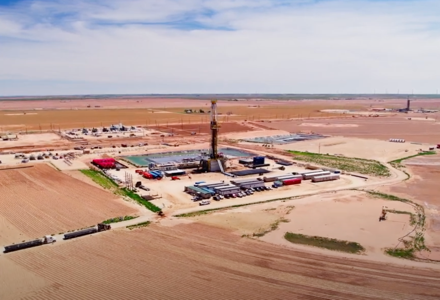
For most of the past decade, the health of the US oil and gas industry could be measured with a simple proxy: rig count. More rigs meant more drilling, more jobs, and more work flowing to oilfield service companies. That relationship has now decisively broken.
Today, US oil producers are drilling fewer wells, running fewer rigs, and yet producing more oil than ever before. The shift is structural, not cyclical — and it is fundamentally reshaping the Oilfield Services (OFS) market.
The New Reality: Fewer Wells, Higher Output
US crude oil production reached record levels in 2025 even as oil rig counts declined year-over-year. At first glance, this appears contradictory. In reality, it reflects a profound transformation in how oil is extracted.
Producers are concentrating activity in their best acreage and extracting more hydrocarbons per well through:
- Longer horizontal laterals, often exceeding two miles
- Faster drilling cycles, reducing days on rig
- Advanced completion techniques, improving recovery rates
- AI and data analytics, improving well placement and productivity
In the Permian Basin, lateral lengths are now more than 50% longer than a decade ago, and many wells produce volumes once associated with multiple legacy wells. A single high-spec rig today can replace several rigs from the previous shale cycle.
The result is a new equation: productivity has replaced activity as the primary driver of growth.
Why Operators Are Comfortable Drilling Less
Efficiency alone doesn’t explain the slowdown in drilling. Producers are also behaving differently because the market is demanding it.
Oil prices remain volatile and struggle to sustainably clear levels that would justify aggressive expansion. At the same time, shareholders continue to reward capital discipline, not production growth for growth’s sake. Add in geopolitical uncertainty, trade tensions, and OPEC supply dynamics, and the incentive to “drill at all costs” disappears.
The rational response has been to:
- Maximise returns from existing acreage
- Extend the life of high-quality inventory
- Lock in predictable costs
- Avoid overcommitting capital in an uncertain market
This strategy is working for producers. It is far more challenging for the service sector.
The OFS Impact: Same Industry, Very Different Outcomes
The shift to drilling fewer wells has not reduced demand evenly across the oilfield. Instead, it has compressed and concentrated it — and that has profound implications for OFS companies.
1. Fewer Wells Mean Fewer Entry Points
Even though production is rising, fewer wells mean fewer opportunities for:
- Mobilisation work
- Short-term contracts
- Spot-market services
- New vendor introductions
Pad drilling and factory-style development reward scale and incumbency. Smaller OFS companies that once relied on steady well counts now find themselves competing harder for a shrinking pool of work.
2. Pricing Power Has Shifted to Operators
Large operators, drilling fewer but more valuable wells, are:
- Bundling services
- Locking in long-term contracts
- Prioritising preferred vendor lists
This has pushed pricing power upstream, compressing margins for OFS firms — particularly smaller, single-basin operators that lack negotiating leverage.
3. Capital Discipline Is Being Passed Down the Chain
Operators’ focus on free cash flow has cascading effects:
- Longer payment terms
- Slower contract awards
- Deferred equipment upgrades
- Hiring freezes or layoffs
Recent survey data shows a majority of small oil and gas businesses now describe themselves as struggling — a reflection not of collapsing activity, but of tightening economics.
4. A Barbell Market Is Emerging
The OFS market is splitting into two groups:
Winners
- Large, integrated service providers
- Technology-enabled firms
- Companies tied to Tier-1 acreage
- Vendors embedded in operator workflows
Strugglers
- Labor-intensive service providers
- Commodity offerings
- Single-basin operators
- Firms dependent on rig-count growth
This divergence explains why production headlines remain strong while sentiment among OFS companies weakens.
Why Sentiment Matters More Than Rig Counts
Confidence drives hiring, investment, and growth. When OFS companies perceive instability — even amid steady work — they pull back:
- Delaying capex
- Reducing headcount
- Cutting sales and marketing spend
That defensive posture reinforces stagnation, particularly among smaller firms without balance-sheet flexibility.
The Bottom Line
The US oil industry has not slowed — it has evolved. Fewer wells are producing more oil, and efficiency has replaced scale as the defining competitive advantage. For operators, this has delivered record output with disciplined spending. For oilfield service companies, it has created a far tougher operating environment.
The challenge for OFS is no longer whether drilling will return to prior peaks. It is whether service companies can adapt to a market where fewer wells carry more value, competition is more intense, and efficiency — not volume — determines survival.
In this new shale era, drilling less does not mean doing less. But for oilfield services, it means only the most focused, differentiated, and resilient firms will thrive.