
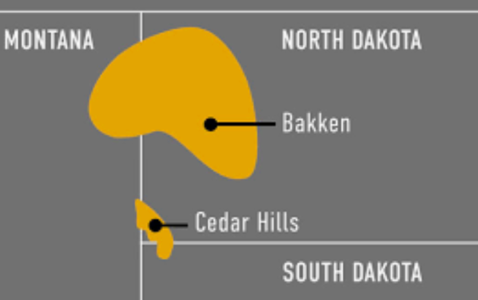
The Bakken formation in North Dakota has been one of the most important energy discoveries in modern North American history. Over the past two decades, the region transformed from a relatively quiet oil province into a global hub for shale innovation. Today, industry leaders and policymakers believe the next major breakthrough could come from CO₂ enhanced oil recovery (EOR)—a technology that could unlock billions of additional barrels of oil and extend the life of the Bakken for decades.
The Rise of the Bakken
The Bakken formation, located primarily in western North Dakota and eastern Montana within the Williston Basin, contains vast hydrocarbon resources trapped in tight shale rock. While the presence of oil in the Bakken had been known for decades, it was largely considered uneconomic until the mid-2000s.
The breakthrough came through the combination of two technologies:
- Horizontal drilling
- Hydraulic fracturing
These technologies allowed operators to access oil trapped within extremely low-permeability rock. As drilling and completion techniques improved, production surged.
North Dakota rapidly became one of the leading oil-producing states in the United States.
Today:
- North Dakota is the third-largest oil producing state in the country.
- The Bakken produces over one million barrels of oil per day in peak periods.
- More than 20,000 wells have been drilled across the formation.
The oil boom transformed the state’s economy, generating billions in tax revenue, creating thousands of jobs, and driving major investments in infrastructure.
The Bakken Recovery Challenge
Despite its success, the Bakken still faces a major technical challenge: low recovery rates.
Unlike conventional reservoirs, shale formations trap oil within extremely tight rock. Even with modern drilling and fracturing techniques, operators typically recover only 5–10% of the oil in place.
This means that the vast majority of hydrocarbons remain trapped in the reservoir after primary production.
As many Bakken wells mature, the issue becomes more visible. Out of roughly 20,000 Bakken wells, about 13,000 have reached marginal production levels, producing around 35 barrels per day or less.
The question facing operators and policymakers is simple:
How can the industry extract more oil from existing wells and reservoirs?
The answer may lie in enhanced oil recovery.
What Is CO₂ Enhanced Oil Recovery?
Enhanced Oil Recovery (EOR) refers to techniques used to increase the amount of oil that can be extracted from a reservoir after primary production declines.
One of the most proven methods is CO₂ injection.
The process works by injecting carbon dioxide into the reservoir, which:
- Increases reservoir pressure
- Reduces oil viscosity
- Allows trapped oil to flow more easily toward producing wells
CO₂ EOR has been successfully used for decades in conventional oil reservoirs, particularly in regions such as the Permian Basin.
However, applying it to tight shale reservoirs like the Bakken presents new challenges.
“Crack the Code 2.0”: North Dakota’s Strategy
Recognizing the potential of enhanced recovery, North Dakota has launched a new initiative known as “Crack the Code 2.0.”
The program aims to accelerate research and collaboration between:
- Oil producers
- Coal-fired power plants
- Carbon capture developers
- Research institutions
The goal is ambitious:
Double the oil recovery rate in the Bakken.
If successful, CO₂ injection could potentially unlock at least 5 billion additional barrels of oil from the formation.
That would represent one of the most significant resource expansions in North American shale.
A New Role for Coal Plants
One unique aspect of the initiative is the potential role of coal-fired power plants.
North Dakota still operates several coal power facilities that emit large volumes of carbon dioxide. Instead of viewing CO₂ purely as an emissions problem, policymakers are exploring ways to capture and monetize the carbon.
Captured CO₂ could be:
- Transported via pipelines
- Sold to oil producers
- Injected into Bakken reservoirs
This approach could create a new revenue stream for power plants while simultaneously improving oil recovery.
Preliminary estimates suggest that full-scale Bakken EOR could require around 100 million tons of CO₂ per year, far more than current in-state emissions. This means additional carbon capture projects and CO₂ infrastructure would likely be needed.
Infrastructure and Investment
To support these efforts, North Dakota has begun investing in energy infrastructure and research.
The 2025 state legislature approved $25 million in funding for improved oil recovery research through the Oil and Gas Research Council.
Several pilot projects are currently under consideration, focusing on:
- CO₂ injection tests
- Rich gas injection
- Reservoir pressure maintenance
The state is also supporting infrastructure projects such as the Bakken pipeline system, which will help deliver energy resources and support regional development.
The Technology Challenge
Applying CO₂ EOR to the Bakken is not straightforward.
Traditional EOR methods such as water flooding and gas injection were developed for conventional reservoirs, which have much higher permeability.
The Bakken is fundamentally different.
Its tight shale formations require innovative approaches to:
- CO₂ injection design
- Fracture network management
- Reservoir pressure control
- Well spacing optimization
The first milestone will be technical success—demonstrating that CO₂ injection can significantly improve recovery in shale reservoirs.
The second milestone will be economic success. Operators must be able to deploy these technologies at a cost that generates acceptable returns.
The Role of Technology and AI
Advanced analytics and artificial intelligence may play a role in solving the Bakken EOR puzzle.
AI-driven modeling can help operators:
- Analyze reservoir behavior
- Optimize injection strategies
- Improve well placement
- Predict production outcomes
Combining these tools with decades of Bakken operational data could accelerate the development of economically viable EOR strategies.
Why the Bakken Still Matters
The Bakken has long been a proving ground for energy innovation.
Technologies pioneered in North Dakota helped shape the broader shale revolution and influenced oil and gas development worldwide.
If CO₂ enhanced oil recovery succeeds in the Bakken, the implications could extend far beyond the Williston Basin.
Shale basins around the world—from the Permian Basin to Argentina’s Vaca Muerta—could potentially apply similar techniques.
In that sense, the Bakken could once again become a global laboratory for the next generation of oil recovery technologies.
Looking Ahead
North Dakota’s energy leaders believe the next chapter of the Bakken is just beginning.
With strong policy support, collaboration between industry and government, and continued technological innovation, CO₂ enhanced oil recovery could significantly expand the life of the formation.
For operators, the opportunity is enormous: billions of barrels of additional oil, improved economics for mature wells, and a new model for integrating carbon capture with energy production.
The Bakken helped launch the shale revolution.
The question now is whether CO₂ enhanced oil recovery can launch the next one.

Author: phinds