
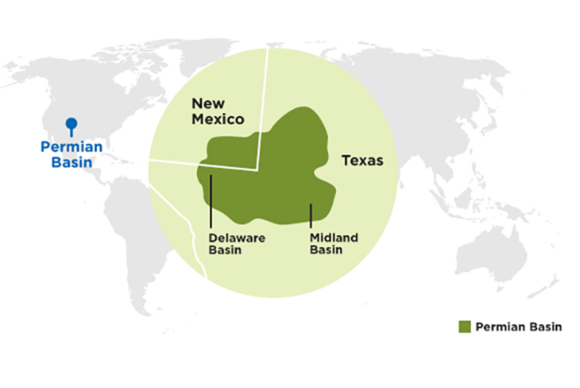
While the Permian Basin continues to dominate North American oil and gas production, a new layer of growth is emerging beneath the surface.
Newly added plays still account for only about 5% of total Permian production—but they are expanding rapidly. Since 2022, these zones have more than doubled oil production and increased gas output by 72%. The data points to a clear shift: newer unconventional intervals are becoming increasingly important contributors to future Permian growth.
One of the most compelling examples is the Barnett Shale in the Permian Basin.
Barnett Shale: Early-Stage, High-Cost, High-Potential
The Barnett program is still in the delineation and early development phase, which explains its current cost structure and operational profile.
Today, drilling costs sit at approximately $1,000 per lateral foot, significantly higher than core Midland Basin wells. These elevated costs are typical of early-stage development and are driven by:
- Limited pad drilling
- Ongoing operational learning curves
- Lack of full-scale manufacturing efficiencies
However, operators are already working toward meaningful cost reductions. Diamondback, for example, is targeting ~$800 per lateral foot, with improvements expected from:
- Multi-well pad drilling
- Simul-frac completions
- Longer laterals (~15,000 feet)
- Increased drilling efficiency
Barnett Shale – Permian Activity Overview (CY + PY)
Recent well data confirms that Barnett activity remains relatively small but highly focused, consistent with an early-stage play.
Total wells analyzed: ~120
Top Operators
| Operator | Wells |
|---|---|
| Fasken Oil and Ranch, Ltd. | 39 |
| BTA Oil Producers | 17 |
| Continental Resources | 16 |
| Mewbourne Oil Company | 11 |
| Blackbeard Operating, LLC | 6 |
Top Counties
| County | Wells |
|---|---|
| Midland | 39 |
| Crane | 31 |
| Andrews | 25 |
| Ector | 20 |
| Upton | 3 |
What this tells us:
- Activity is highly concentrated among a small group of operators
- Development is focused in the core Midland Basin footprint
- Operators are still in delineation mode, not full-scale development
The Key Advantage: Superior Productivity
Despite higher costs today, the Barnett stands out for one critical reason—productivity per foot.
Metric Midland Core Barnett Cost per lateral foot ~$510–520 ~$1,000 (target ~$800) Productivity ~50 BO/ft ~75 BO/ft Production per 1,000 ft ~22 MBOE ~36 MBOE
Barnett wells are delivering roughly 50% higher production per lateral foot compared to core Midland wells.
This is the key to the entire story.
While the Barnett is currently more expensive to develop, its stronger recovery per foot creates a pathway to highly competitive economics—especially as costs decline.
Why This Matters: From Niche to Growth Driver
The Barnett highlights a broader trend playing out across the Permian:
New plays are not yet scale plays—but they are conviction plays.
Operators are:
- Deploying capital despite higher costs
- Concentrating activity in core areas
- Prioritizing learning and optimization
This behavior signals confidence that these zones will transition from delineation to full-scale manufacturing over time.
As drilling techniques improve and costs fall, these plays could rapidly move from a 5% contributor to a meaningful share of Permian growth.
Final Takeaway
The next phase of Permian growth may not come from the core—it may come from what lies just beyond it.
The Barnett Shale shows that:
- Early-stage plays can carry higher costs
- Strong productivity can justify continued investment
- Focused operator activity is laying the groundwork for scale
New plays are still small—but they are growing fast, and they are becoming increasingly important to the future of the basin.

Author: phinds