
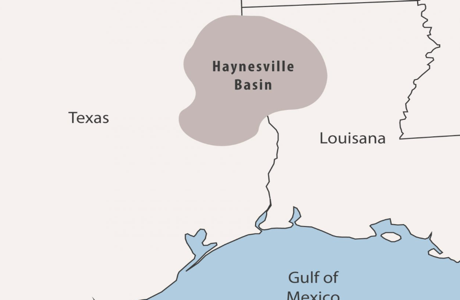
For years, the Haynesville was treated as a single, uniform shale play—one of the most repeatable natural gas basins in North America.
That assumption no longer holds.
Today, the Haynesville has clearly bifurcated into two distinct geological regimes. And that split is doing more than just changing well depths—it’s reshaping how operators develop the basin.
This is no longer a story about operator strategy.
It’s a story about subsurface reality.
🪨 A Basin Divided: Two Haynesvilles, Not One
At a geological level, the Haynesville now operates as two different systems:
1. The Traditional Core Haynesville
Depth: ~10,000–14,000 ft
Location: De Soto, Caddo, Red River core fairway
Key Characteristics:
- Overpressured reservoir
- Thick, laterally continuous shale (200–300 ft)
- Consistent rock quality across large areas
- Strong initial production rates
This is the Haynesville that built the play’s reputation.
It’s predictable. It’s repeatable. And most importantly—it behaves consistently from well to well.
2. The Next-Generation (Deep) Haynesville
Depth: ~18,000–23,000+ ft
Includes: Lower Haynesville benches, Bossier integration
Key Characteristics:
- Higher temperatures and pressures
- More complex stress regimes
- Variable rock properties (facies changes, mineralogy shifts)
- Greater sensitivity to completion design
This is not simply a deeper version of the same play.
It is a fundamentally different geological environment.
🧠 Why This Matters: Geology Determines the Operating Model
The most important shift in the Haynesville isn’t depth—it’s how geology dictates development strategy.
Here’s the core insight:
In the Haynesville, geology determines whether you operate a factory—or an engineering system.
⚙️ The Core Haynesville: Built for Manufacturing
In the traditional core, the geology removes uncertainty.
- The landing zone is well understood
- Reservoir properties are laterally consistent
- Pressure regimes are predictable
That combination enables something powerful: standardization.
Operators can:
- Drill the same target repeatedly
- Use consistent completion designs
- Scale pad development efficiently
There is little need to experiment across benches or redesign wells.
Because the subsurface is stable, performance variability is low.
➡️ Result:
Execution—not subsurface learning—becomes the competitive advantage.
This is what defines a manufacturing model:
- Repeatable wells
- Predictable outcomes
- Cost and speed optimization
Operators working in this regime are not solving geology.
They’ve already solved it.
They’re optimizing execution.
🔬 The Deep Haynesville: Built for Engineering
Move deeper into the basin, and the rules change.
The Haynesville transitions into a more complex, stacked system—often involving:
- Lower Haynesville intervals
- Bossier shale integration
- Variable depositional environments
This introduces:
- Changes in mineralogy and rock fabric
- Variable total organic content (TOC)
- Different fracture behavior across zones
At these depths, temperature and pressure increase significantly, further impacting completion performance.
The result is a reservoir that is no longer uniform.
It must be understood, tested, and engineered.
What This Forces Operationally
In deeper Haynesville development, operators cannot rely on repetition alone.
They must continuously optimize:
- Completion design
(proppant loading, stage spacing, fluid systems) - Landing zone precision
(targeting the most productive intervals) - Well performance over time
(decline management and EUR optimization) - Cost structure
(as deeper wells carry higher capital intensity)
➡️ Result:
Performance is driven by design—not just execution.
This is an engineering model:
- Iterative improvement
- Data-driven decision making
- Continuous optimization
⚖️ Same Basin, Different Systems
The distinction becomes clear when viewed side-by-side:
Dimension Core Haynesville Deep / Next-Gen Haynesville Depth ~10–14k ft ~18–23k+ ft Geology Uniform, laterally continuous Stratigraphically complex Reservoir Behavior Stable, repeatable Variable, sensitive Zone Strategy Single primary interval Multi-zone / stacked Development Model Pad-based manufacturing Distributed, engineered Completion Approach Standardized Continuously evolving Competitive Advantage Speed + cost efficiency EUR + design optimization
🧭 Where Operators Fit In (Supporting, Not Leading)
This geological split is already visible in operator behavior.
Some operators are concentrated in the core Haynesville, where:
- Depths cluster tightly
- Landing zones are consistent
- Development resembles a manufacturing system
Others are pushing into the deeper Haynesville-Bossier system, where:
- Wells are significantly deeper
- Field footprints are broader
- Performance depends on completion innovation
But the key point is this:
The difference between operators is not strategy—it’s geology.
Operators are adapting to the rock they are given.
🔥 The Bigger Shift: From Resource Play to Engineering System
The Haynesville is no longer just a drilling play.
It is becoming a completion-driven, engineering-led system—especially in its deeper intervals.
This shift is supported by broader industry trends:
- Longer laterals
- Higher fluid and proppant volumes
- Increasing focus on EUR over initial production
- Continuous iteration in completion design
What used to be a race to drill faster is now, in many areas, a race to design better wells.
🧠 Final Takeaway
The Haynesville hasn’t just matured.
It has split.
- Shallow, uniform rock enables manufacturing
- Deeper, stacked geology forces engineering
And that distinction is now the defining feature of the basin.

Author: phinds