
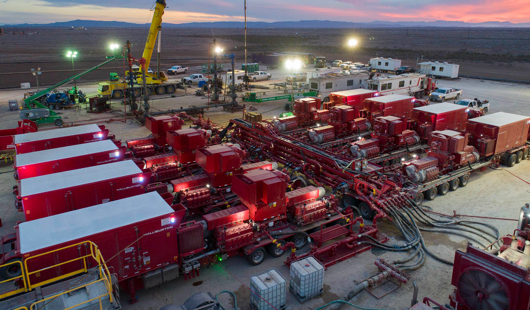
ConocoPhillips is sending a clear message to the oilfield services sector: keeping frac crews working remains a top operational priority. During its Q1 2026 earnings call, company executives explained that improvements in completion efficiency are now outpacing drilling gains, prompting the operator to add another drilling rig in the Delaware Basin to prevent “frac gaps” and maintain a continuous flow of wells into completion.
The decision reflects a manufacturing mindset that has become increasingly common among large U.S. shale operators. Rather than allowing hydraulic fracturing crews to sit idle while waiting for drilled wells, ConocoPhillips is adjusting its drilling program to ensure a consistent inventory of completed wells is available. Management emphasized that maintaining a level-loaded development program is more valuable than maximizing short-term drilling efficiency if it results in interruptions to completion activity.
This strategy is supported by continued gains in drilling and completion performance. The company reported approximately 15% improvements in drilling and completion efficiencies exiting 2025, with completion operations continuing to improve faster than drilling during 2026. These operational gains are allowing ConocoPhillips to accelerate development while maintaining capital discipline and supporting higher returns from its Delaware Basin assets.
For oilfield service companies, the implications are significant. A commitment to eliminating frac gaps translates into stronger demand for pressure pumping services, completion chemicals, proppant, water management, wireline, coiled tubing, logistics, and other completion-related services. Maintaining continuous frac operations also supports higher equipment utilization and more predictable scheduling for service providers throughout the development program.
The company’s comments reinforce a broader trend emerging across North American shale development. As operators continue to industrialize field operations, the objective is no longer simply drilling wells faster—it’s optimizing the entire development system. Drilling, completions, facilities, and production are increasingly managed as an integrated manufacturing process where minimizing downtime between each stage creates greater value than optimizing any single operation independently.
Industry Impact
ConocoPhillips’ focus on avoiding frac gaps demonstrates that completion activity remains a critical operational bottleneck in modern shale development. For oilfield service companies, suppliers, and infrastructure providers, sustained utilization of frac crews signals continued demand across the completions value chain as operators prioritize uninterrupted development programs over isolated drilling gains.
ConocoPhillips discussed frac activity and completion efficiency several times during the Q1 2026 earnings call. The key message was that completion (frac) efficiency is improving faster than drilling efficiency, leading the company to increase activity to keep its frac crews fully utilized.
Key takeaways on frac
1. Completion efficiencies are outpacing drilling efficiencies
- Management said their completion operations continue to improve faster than drilling.
- Because of these gains, they are adding another Permian rig to ensure enough wells are available for the frac crews.
- Their goal is to maintain a steady-state, level-loaded operation rather than allowing completion crews to sit idle.
2. Avoiding “frac gaps” is a priority
Nicholas Olds explained:
- ConocoPhillips does not want any gaps in frac work caused by drilling becoming the bottleneck.
- The additional rig is being added specifically to maintain a continuous flow of wells into completion.
- As drilling and completion efficiencies improve, the company wants to preserve its manufacturing-style development model.
3. Delaware Basin is receiving the additional activity
The increased capital spending (~$250 million midpoint increase) is focused on the Delaware Basin and includes:
- Additional operated drilling activity.
- Higher non-operated (OBO) participation where partners are proposing additional wells.
- The company views these as high-return, low-cost opportunities worth pursuing.
4. Continued improvement in D&C efficiency
Management highlighted:
- Approximately 15% improvement in drilling and completion (D&C) efficiencies exiting 2025.
- Those efficiency gains are continuing into 2026.
- Completion efficiencies are currently improving even faster than drilling.
5. Long-term operational strategy
Ryan Lance emphasized that these decisions are operational rather than commodity-price driven.
The company intends to:
- Keep its “efficient machine” running.
- Avoid being drilled out of inventory by partners.
- Maintain continuous drilling and frac operations heading into 2027.

Author: phinds