
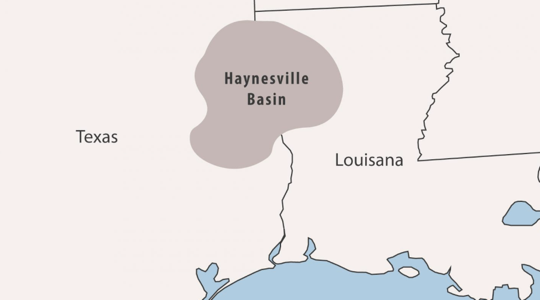
Enterprise Products Partners offered a direct assessment of the Haynesville during its second-quarter 2026 earnings call: the dry gas basin remains highly dependent on natural gas prices. Natalie Gayden, senior vice president of natural gas assets, described it as a “one-trick pony” and said Enterprise continues to view it as a “swing basin.”
For operators and service companies, those comments highlight a competitive challenge: Haynesville drilling must earn its return primarily from natural gas, while significant volumes of competing Permian gas arrive alongside oil production.

Why Haynesville Is Price Sensitive
Enterprise’s description reflects the Haynesville’s reliance on a single principal commodity. Without substantial oil revenue supporting well economics, natural gas prices play a central role in determining whether producers accelerate drilling, defer completions or hold activity steady.
The U.S. Energy Information Administration has documented that relationship. Haynesville production declined in 2024 as producers reduced drilling in response to historically low gas prices. Permian gas growth, meanwhile, was supported by associated gas produced during oil extraction.
Calling Haynesville a swing basin means its incremental supply responds to market economics. When demand strengthens and prices justify investment, producers have an incentive to add production. When competing supply keeps prices weak, the incentive to drill additional wells diminishes. That response takes time because drilling, completions and infrastructure require planning and capital.
How Permian Gas Creates Pressure
The Permian operates under a different economic model. Oil revenue can support drilling that also produces natural gas, allowing gas supply to grow even when gas prices alone would provide a weaker investment case. EIA identifies crude oil production as the primary driver of associated gas growth in the region.
The implication for Haynesville is that additional Permian gas can meet part of the market’s growing demand before new Haynesville wells are needed. If supply grows faster than consumption and exports, it can limit the price improvement required to encourage more dry gas drilling.
Pipeline capacity determines how quickly that competition reaches downstream markets. Enterprise discussed approximately 2 Bcf/d of potential returning Permian production, much of it from wells that had been choked back because of weak Waha economics. New takeaway capacity can allow those existing volumes to reach buyers without requiring an equivalent wave of new drilling.
Management also pointed to higher gas-to-oil ratios as a source of future Permian gas growth. Together, returning production and increasing gas volumes per barrel of oil could keep pressure on the economics of incremental Haynesville supply. This is a market implication of Enterprise’s comments, rather than a specific Haynesville price forecast.
Strong LNG Demand Still Supports Haynesville
Enterprise’s assessment was not uniformly cautious. Management said Haynesville production had gradually increased during the year and was approaching 16 Bcf/d. Its Haynesville Extension pipeline was fully contracted, as was its Gillis lateral serving LNG markets, which was moving approximately 800 MMcf/d to 1 Bcf/d.
Those comments show that strong transportation demand can coexist with price-sensitive upstream activity. LNG demand supports the need for gas, but the volume Haynesville must supply depends partly on how much competing production reaches the market.
Industry Impact
For drilling contractors, completion providers and equipment suppliers, Haynesville opportunities depend on both demand growth and the pace of Permian supply additions. Rising LNG demand can support activity, while new Permian pipelines and returning associated gas can moderate the price signal needed for further drilling. Enterprise’s message was that Haynesville remains an important source of supply—but the economics determine when the market calls on its next increment.

Author: phinds