
Large capital projects still overshoot budgets by 30 to 45 percent, McKinsey reports. The culprit is latency: crews spot a scope hit, yet the cost lives in spreadsheets and the delay in a scheduler’s private file. Weeks pass before the official Estimate at Completion shifts: by then, choices are gone.
In this guide, we compare six capital-project forecasting tools built for owners like you. Each one surfaces potential change within hours, links cost and schedule, and protects the baseline you report upstream.
What “forecast accuracy” means when change orders hit
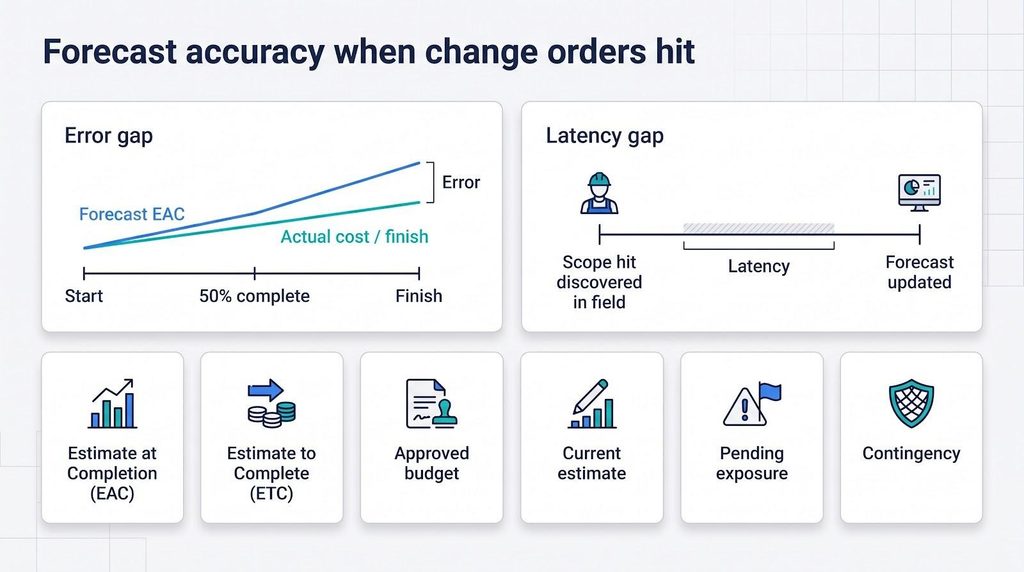
Forecast accuracy tracks two gaps: the distance between the cost or finish date you show today and the outcome you finally deliver, and the delay before new scope appears in that forecast.
Owners measure those gaps in two ways:
- Error: the difference between a project’s estimate at completion (EAC) and its actual cost or completion date
- Latency: the time it takes a newly discovered scope hit to appear in that EAC
To keep those metrics honest, you need six separate buckets:
- Estimate at completion (EAC): running projection of total spend
- Estimate to complete (ETC): cost still ahead of you
- Approved budget: dollars the board released
- Current estimate: a sandbox that flexes as potential changes surface
- Pending exposure: every cost or schedule ripple you can see but have not approved
- Contingency: the safety net you draw on, not a slush fund
The Federal Transit Administration’s January 2025 Project and Construction Management Guidelines call for tracking potential change orders, with their status and estimated cost, so leaders can act before overruns harden into headlines.
When a platform blurs these lines, accuracy becomes guesswork. When it preserves them, you spot trouble fast enough to steer.
How we ranked these platforms
We scored each tool on seven owner-centric criteria, weighted by the factors that move forecast accuracy the most:
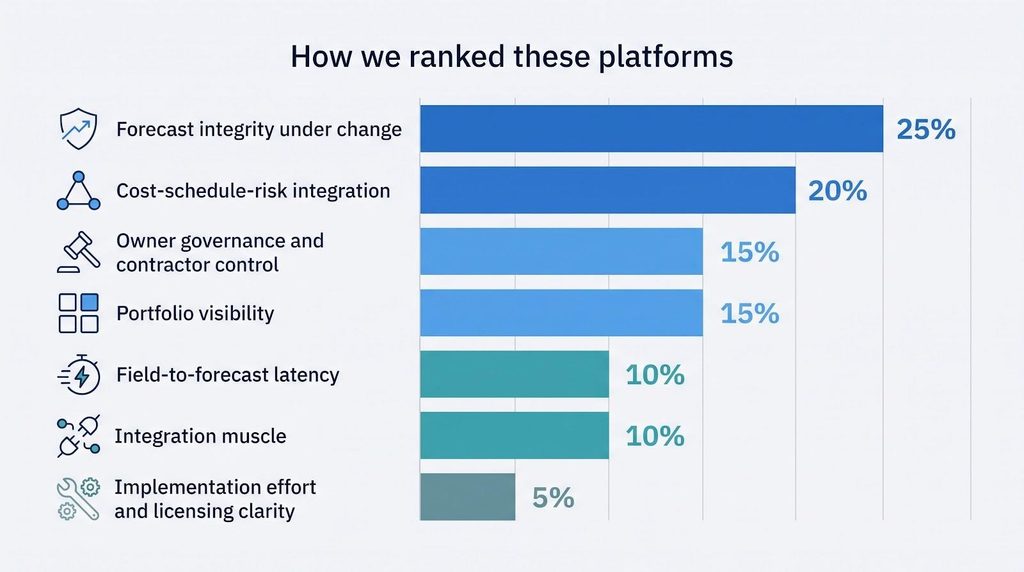
- Forecast integrity under change (25 %): can potential and pending impacts enter the Estimate at Completion without touching the approved baseline?
- Cost-schedule-risk integration (20 %): do cost sheets, CPM activities and probabilistic risk models update together in real time?
- Owner governance and contractor control (15 %): delegated-authority workflows, audit trails and separate contractor portals.
- Portfolio visibility (15 %): normalised roll-ups that compare projects, contractors and funding sources.
- Field-to-forecast latency (10 %): speed at which new quantities, actuals and commitments refresh the EAC.
- Integration muscle (10 %): depth of SAP, Primavera P6 and document interfaces.
- Implementation effort and licensing clarity (5 %): time to first live report and transparency of commercial terms.
We gave zero weight to flashy extras such as mobile skins, AI chat bots or generic project-management add-ons. That filter cut the longlist to six platforms that surface change within hours, not weeks.
At a glance: how the six platforms stack up
The table below shows which tools belong on an owner’s shortlist before you dive into the detailed reviews.
| Rank | Platform | Best for | Pending change enters EAC? | Cost-schedule-risk depth | Portfolio roll-up | Implementation effort* |
| 1 | InEight | Integrated owner controls | Yes (current-estimate sandbox) | Native CPM, Monte Carlo | Enterprise dashboards | Medium-high |
| 2 | Octave Sequence Enterprise | Enterprise governance | Yes | P6, ERP, risk register | Capital-allocation view | High |
| 3 | Oracle Primavera stack | Formal workflow and scheduling | Yes | P6 or Primavera Cloud, Unifier risk | Unifier portfolio sheets | High |
| 4 | Contruent | Controls-first deployment | Yes | P6 import, EVM | Multi-project BI packs | Medium |
| 5 | Cleopatra | Refinery and chemical turnarounds | Yes | P6 bidirectional, turnaround risk | Cost-center roll-ups | Medium |
| 6 | Kahua | Configurable owner PMIS | Yes | P6 import via Schedule Manager (Oct 2026) | Funding-source roll-ups | Medium-high |
*Implementation effort is an editorial assessment of public case studies and vendor documentation, not a guaranteed timeline.
Every platform in the table treats pending change as primary data, and each ties cost sheets to a CPM backbone. They differ in governance depth, portfolio scale and the configuration work you need to commit.
1. InEight: best overall for integrated owner forecasting
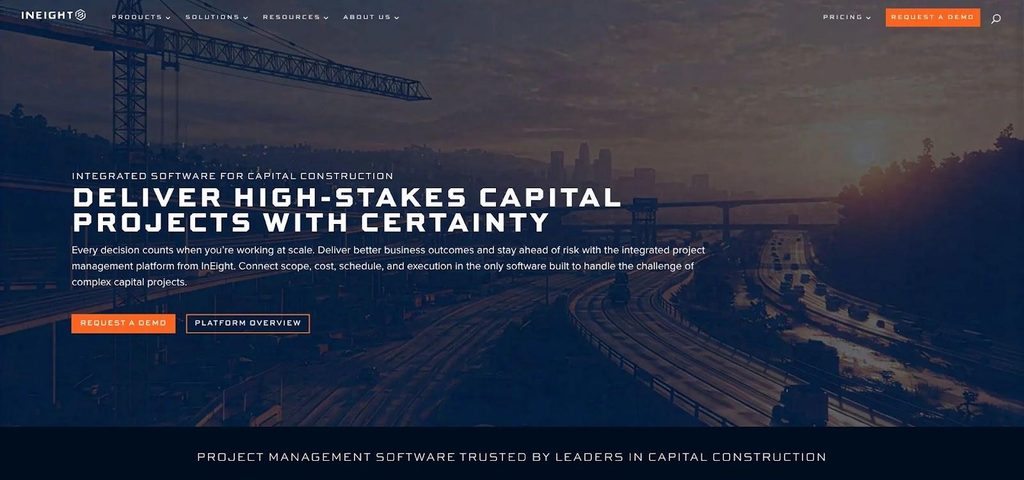
InEight integrated construction project controls platform screenshot
InEight ranks first because it treats the construction life cycle as one connected dataset and delivers time-phased budgeting and forecasting that aligns budgets with real-time progress. That capability places it firmly among the leading options for capital project forecasting software. Estimate, schedule, cost, contract, change, field progress and risk live in one model, so you stop stitching reports together after the fact.
The current estimate sandbox is the centrepiece. Teams price every pending change as soon as it appears, while the approved budget stays locked. The Estimate at Completion refreshes in real time, closing the blind spot between discovery and decision.
Schedule data speaks the same language. Activities feed cost codes, quantities drive progress and Monte Carlo risk sits on top. Shift two tie-in activities and the cash-flow curve and finish date move automatically: cost, time and risk stay on one screen.
That shared view helps teams spot margin drift early and capture change orders before they are lost in month-end close. An audit trail records who changed what and when, evidence regulators and JV partners demand.
Implementation happens in phases. Most buyers start with Control for cost and change, then add Schedule, Plan and Document as processes mature. The full platform is priced by quote, and teams that want to pilot first can start with per-user InEight NOW subscriptions for Estimate, Schedule, Document, and Compliance & Completions.
If you want one platform that follows a work item from first estimate through turnover, and you are ready to align every team on a common WBS, InEight sets the benchmark.
2. Octave Sequence Enterprise: best for enterprise cost governance
Octave Sequence Enterprise project performance platform screenshot
When your capital programme spans countries and currencies, governance beats gadget count. Sequence Enterprise (rebranded from EcoSys in 2026) standardises how global owners plan, fund and forecast. Every project rolls into one enterprise model that mirrors the chart of accounts, funding sources and approval limits, so a stakeholder in Doha or Corpus Christi sees the same real-time variance under one rule set.
Change exposure stays visible without touching the board-approved budget. Potential, pending and approved values each sit in their own column and can be time-phased across the cash curve. Rolling forecasts, earned value and contingency drawdowns all run from that shared workbook instead of a patchwork of linked spreadsheets.
Sequence links to SAP for actuals, Primavera P6 for schedules and common procurement or timesheet feeds. That depth lets teams spend energy enforcing discipline, not re-keying data. In one deployment, Technip Energies cut a materials-data process from ten days to ten seconds after going live, a clear win on latency.
Flexibility is the trade-off. Because the platform is highly configurable, policies that live in a controls manual today must become dropdowns and validation rules tomorrow. Large owners often pair the rollout with a multi-year data-standardisation drive. Choose another tool if you need a quick, low-change implementation, but if you want a governed heartbeat across a multi-billion-dollar portfolio, Sequence delivers it.
3. Oracle Primavera Unifier + P6 / Primavera Cloud: best for formal workflow and scheduling
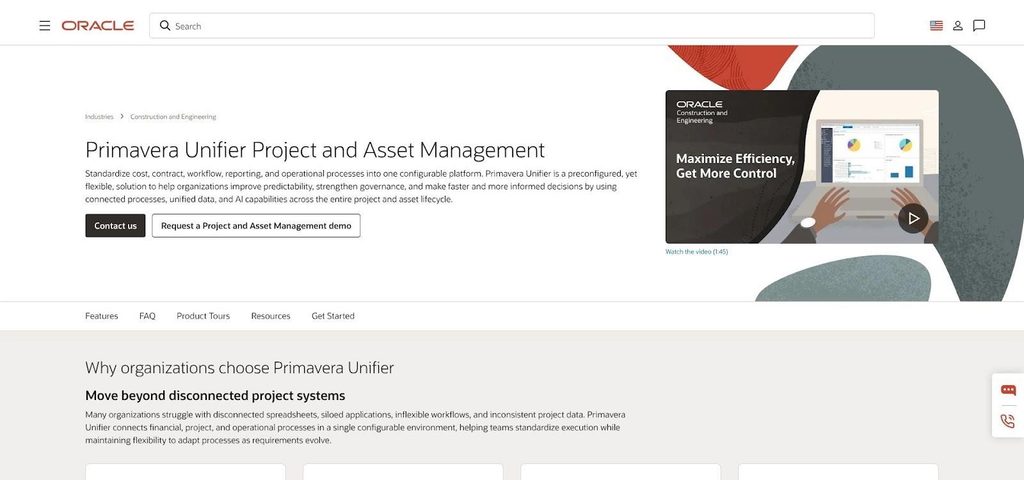
Oracle Primavera Unifier and P6 project controls ecosystem screenshot
If your contracts lock in P6, Oracle extends that backbone by pairing the CPM engine with Unifier for cost, change, funding and cash flow.
Here, the schedule drives the numbers. A planner updates activities in P6 or Primavera Cloud, then Unifier pulls the dates and reshapes the cash curve and exposure forecast automatically. Approve one change order, and the stack updates budget lines, commitments, payment applications and the finish date without re-keying.
You gain governance first. Configurable workflows pin monetary-authority thresholds, route each pending change through digital signatures and store a forensic audit trail. Regulators and programme auditors value that clarity, while finance teams rely on the direct link to Oracle ERP. The core benefit is simple: nothing posts to the ledger until the right person signs.
Results back it up. Saudi contractor Al Mozaini now processes payment applications 50 % faster and with 50 % less effort after moving to Oracle Cloud solutions.
Complexity is the trade-off. You will deploy at least two core products, often three if Aconex manages documents, so budget for a systems integrator, an interface map and a clear RACI.
Pick the Oracle stack when contractual P6 schedules are non-negotiable and compliance requires rigorous approval control. The toolset is heavy, and so is the oversight it delivers.
4. Contruent: best for controls-first deployment
When you need disciplined cost control without a two-year transformation, Contruent (formerly ARES PRISM) gives you a quicker path. The platform zeroes in on the workhorse tasks you run every month: time-phased budgets, earned value, trend logs and change orders. Import the contractor’s P6 schedule, map activities to the cost breakdown structure and every progress update turns into dollars and days you can trust.
The Trend module is pivotal. Field teams log potential issues as soon as they surface, and those estimates flow straight into the working EAC. Executives see exposure early while the formal change order moves through approvals, a practice federal owner guidance endorses.
Results prove the point. Chemicals maker Covestro cut the time spent collecting and validating project data by 90 % and gained more reliable portfolio reporting after adopting Contruent. The gains come from discipline more than dashboards: every cost lives under a WBS code, every change under an approval level and every forecast under audit.
Most owners go live inside a quarter, starting with more than 200 ready-made reports before customising. You still need data governance, but you avoid the blank-sheet design phases that Sequence or Kahua require. If you need proven project-controls depth fast and can feed clean schedule and ERP data, Contruent belongs on your shortlist.
5. Cleopatra: best for refinery and chemical turnarounds
Turnarounds move fast and carry heavy revenue risk. Cleopatra was built for that pace, which is why process-industry owners reach for it when every shutdown hour matters.
The platform links estimating, project controls and historical benchmarking in one loop. You start with a refinery-tuned cost database, add quantities, route the estimate for review, then flip the same data into live cost control once execution starts (no re-keying, no lost assumptions).
Change management keeps up. Field teams tag a scope hit to a work pack and log a rough-order cost, and Cleopatra pushes the exposure into the working EAC right away. Approved change orders then update both cost and the integrated P6 schedule, keeping the cash curve and finish date honest.
The strength shows when brownfield surprises pile on. At Neste, a refinery turnaround processed more than 1 400 field change orders yet still produced cost reports three times a week. That cadence comes from strict code structures and a progress engine that tracks quantities, not opinion-based percent complete.
You still need P6 for deep CPM work and time for SAP interface mapping, but if the board wants tighter forecasting on the next catalyst swap or heat-exchanger rebuild, Cleopatra brings a process-industry playbook the generic suites lack.
6. Kahua: best for configurable owner PMIS workflows
Kahua is a low-code project-management information system that lets you redesign cost, change and funding workflows without calling IT. A public agency can track grant dollars one way, while a private LNG terminal tracks joint-venture equity another way, all on the same platform.
Pending change sits at the centre. A superintendent flags a field condition, the estimating team adds a rough-order cost and Kahua rolls that figure into projected cost within minutes, long before legal language finalises the change order. Executives see exposure early enough to choose a response.
Schedule integration is new. Schedule Manager, launched in October 2026, imports Primavera P6 schedules, compares revisions against approved baselines and ties activities to contracts and schedules of values, so confirm how deep the cost linkage goes in a proof-of-concept.
Collaboration is the headline. External contractors, designers and inspectors log in under role-based permissions, trimming email traffic and eliminating shadow spreadsheets. Asset handover lives in the same record set, so operations teams inherit clean data on day one.
Flexibility carries governance risk. Unlimited form edits can spawn rogue processes unless a design authority enforces naming conventions and approval paths. Budget time up front for that discipline, or agility can turn into inconsistent data.
Choose Kahua when you need owner-grade cost control wrapped in a toolkit you can reshape on the fly, provided you bring a firm hand to process design.
Seven demo tests every owner should run
Slide decks never reveal how a platform behaves once a project veers off script. Put each vendor through the same real-world sequence, then watch the numbers move:
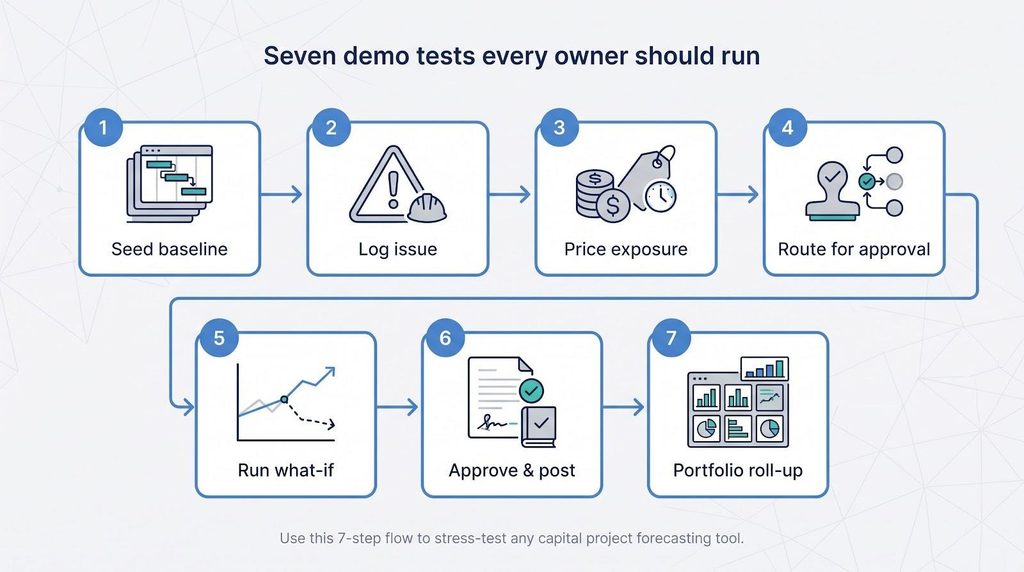
- Seed the baseline. Import the approved budget and the latest P6 schedule. Confirm that WBS and cost codes align without manual tweaks.
- Log a new issue. Enter a field-driven scope hit (RFI, design revision, discovery weld) and time how long it takes to attach evidence and tag affected activities.
- Price the exposure. Add a rough-order cost and likely delay. The Estimate at Completion should update at once while the approved budget and baseline finish stay frozen.
- Route for approval. Push the pending change through delegated authority. Approvers must see cost, schedule and risk impacts on one screen, not three PDFs.
- Run a “what-if.” Before the decision posts, model the change plus a productivity dip and a commodity-price swing. Save and compare scenarios without exporting to Excel.
- Approve and post. After signature, watch the system update budget lines, commitments, cash-flow curve and finish date in one action, with an audit trail of every field change.
- Roll up to portfolio view. Open the executive dashboard and verify that programme-level EAC and contingency draw reflect the new reality. If the tool needs a manual refresh button, data latency will hurt later reporting.
Tools that pass these tests support the habits of the leaders in Dodge’s 2026 digital-maturity study: 80% of those owners can produce project data within hours when a cost or schedule issue arises.
Record each session and apply the same yardstick to every contender. Your capital programme depends on it.
How to measure whether your new tool actually boosted forecast accuracy
Buying software is easy, proving that it pays back is harder. Set the yardstick before implementation and you will know, within one reporting cycle, whether the platform earns its keep.
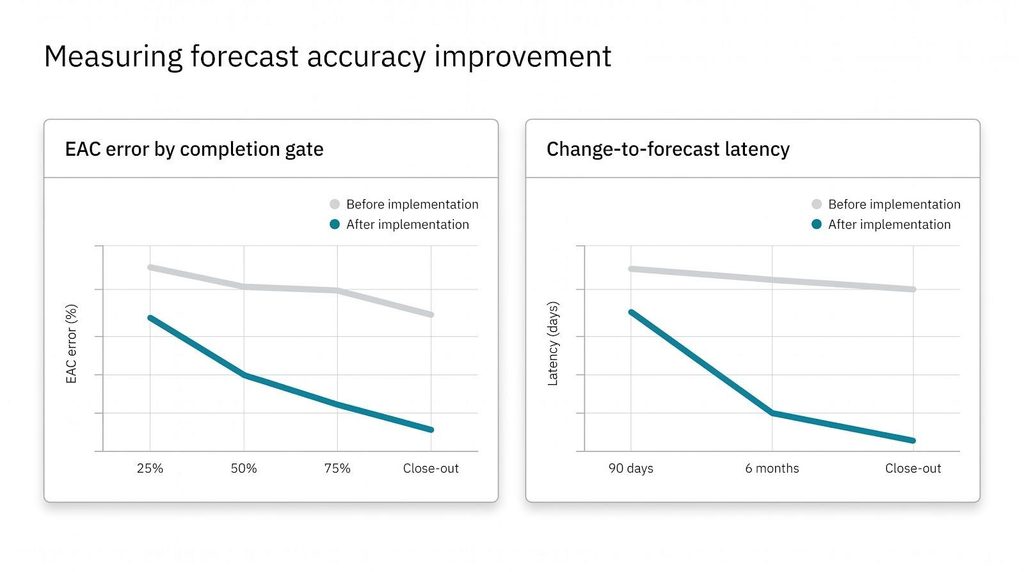
- Error metrics. Record the gap between each project’s estimate at completion (EAC) and its final actual cost at the 25 %, 50 % and 75 % completion gates. Do the same for forecast versus actual finish dates. These numbers form your control group.
- Process-speed indicators. Measure how many days it now takes to pull month-end cost data, price pending changes and publish an approved forecast. Latency often hides more risk than the headline variance.
- Confidence signals. Track how many forecast revisions reach the board each quarter and whether the swings are explainable. Frequent, unexplained shifts usually trace back to delayed change capture.
Re-check at 90 days, six months and first project close-out. Aim for at least a 30 % cut in EAC error or latency by the six-month mark.
Finally, convert accuracy into cash. Every point of forecast error you erase frees contingency dollars you can redeploy or return to investors. When the CFO sees that lift on the balance sheet, the tool’s value speaks for itself.
Final recommendations by owner use case
Match your priority to the shortlist below, and the choice becomes clear.
- Integrated owner platform: InEight: one suite from estimate to field once you standardise WBS, CBS and progress rules.
- Global cost governance: Octave Sequence Enterprise: enforces a single capital-allocation playbook across business units, funding sources and currencies.
- Oracle-centric, regulated programmes: Primavera Unifier + P6 or Primavera Cloud: keeps contractual P6 schedules and ERP-tied approval chains intact.
- Controls-first quick start: Contruent: delivers earned value, trend and change control within months if you supply clean schedule data.
- Refinery and chemical turnarounds: Cleopatra: excels when shutdown windows are counted in hours and discovery work never stops.
- Configurable owner PMIS: Kahua: low-code freedom to reshape workflows project by project, provided a naming-standards gatekeeper is in place.
Across all six platforms, the winning trait is speed. In a 2026 Dodge Construction Network study of large owners, 90% of the most digitally mature owners completed at least three quarters of their projects on or under budget, compared with 33% of the rest. That urgency echoes the FTA’s guidance on tracking potential change orders and McKinsey’s finding that large capital projects still overrun by 30 to 45 percent.
Run the seven-step demo with your top two vendors, choose the one that cuts latency the most, and watch forecast error shrink long before final turnover.
Conclusion
Dashboards and chatbots do not improve forecast accuracy; disciplined data flow does. The platforms that succeed share three traits: they surface pending change within hours, preserve the approved baseline, and tie cost to schedule and risk in one governed forecast.
- InEight: one construction-native suite from estimate to turnover
- Octave Sequence Enterprise: enterprise capital governance across currencies and business units
- Oracle Primavera stack: P6 scheduling plus Unifier’s audited workflows
- Contruent: earned-value and trend control delivered in months, not years
- Cleopatra: designed for refinery and chemical turnarounds
- Kahua: low-code owner PMIS for programmes that revise processes project by project
Federal guidance makes early exposure non-negotiable, and Dodge Construction Network research found that the most digitally mature owners are nearly three times more likely to complete projects on or under budget. Run the seven-step demo, measure how fast each contender updates the Estimate at Completion, and pick the one that turns discovery into decisions before cost and time slip away.