The Haynesville Has Split in Two: Why Geology Now Dictates Development Strategy

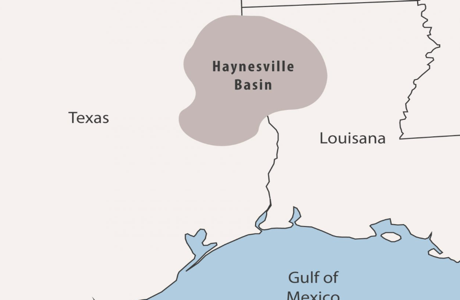
The Haynesville has split into two distinct geological regimes: a shallow, uniform core that enables repeatable, manufacturing-style drilling, and a deeper, more complex system that requires engineered, optimization-driven development.

Ultimately, it’s not operator strategy that defines performance in the basin—it’s the geology dictating whether success comes from execution or design.


read more

The Haynesville Playbook: How Apex Energy Is Standardizing the Path to Faster Gas Development

Apex Energy is executing a factory-style Haynesville development in De Soto and Caddo Parishes by standardizing well depths around a consistent ~12,000 ft target and deploying repeatable 2–4 well pad designs to maximize efficiency. By focusing on one core zone and drilling it repeatedly with multi-rig, pad-based sequencing, the company is accelerating cycle times, lowering costs, and scaling development like a manufacturing process.

read more

The New Haynesville Playbook: How Expand Energy Is Scaling Efficient Gas Development in De Soto Parish

Expand Energy’s De Soto Parish program demonstrates a shift toward a distributed, moderate-density pad model targeting consistent ~22,700 ft Haynesville wells, enabling scalable and capital-efficient development. By leveraging standardized well designs, Gen 3 completions, and AI-driven optimization, the company is improving recovery, lowering breakevens, and building a repeatable “gas factory” model for long-term efficiency.

read more

FireBird Energy II Elizabeth Satellite: A High-Density Wolfcamp Development Signaling Early-Stage Cube Execution in the Midland Basin

FireBird Energy II’s Elizabeth Satellite project demonstrates a two-pad, high-density Wolfcamp development in Upton County, executed through a sequenced drilling approach that improved from multi-rig operations to efficient single-rig cadence. The integration of centralized facility infrastructure and consistent sub-surface targeting reflects an early-stage cube-style development model optimized for repeatability and rapid transition to production.

read more

Fasken Oil and Ranch – Casselman Development Project Overview

The Casselman project represents a multi-section Midland Basin development operated by Fasken Oil and Ranch, deploying 20 horizontal Spraberry wells across 12 clustered pads within several Casselman unit leases in Midland County, Texas. The consistent projected depths, repeatable pad design, and centralized Casselman CTB facility indicate a factory-style development strategy co-developing stacked Spraberry/Wolfcamp benches with a steady drilling cadence of roughly 20 days between wells.

read more

Admiral Permian Resources: A Delaware Basin Factory-Style Development in Loving County

Admiral Permian Resources’ MAVERICKS project in Loving County is a tightly executed Delaware Basin factory-style development, with all wells concentrated on a single pad, drilled by one rig, and landed at identical Wolfcamp depths. The rapid progression from batch permitting to spud and centralized facility authorization confirms a disciplined, repeatable execution model rather than exploratory or opportunistic development.

read more

Diamondback Energy Heidelberg 30-31 Program: A Full-Section Spraberry Factory in Martin County

The Heidelberg 30-31 program in Martin County is a full-section Spraberry cube development executed as a true factory, with 24 standardized horizontal wells drilled in parallel across four pads and four rigs within a single survey block. Identical depths, stacked bench co-development, and a compressed ~8-month permit-to-facility timeline confirm a manufacturing-style model focused on throughput, repeatability, and capital efficiency rather than experimentation.

read more

Inside FireBird Energy’s COYOTE UNIT: Pad-Based Spraberry Development in the Midland Basin

FireBird Energy II’s COYOTE UNIT project offers a clear look at how modern Permian operators execute disciplined, small-footprint development programs without sacrificing speed or efficiency. Concentrated in Borden County and anchored by standardized Spraberry targeting, the project follows a factory-style workflow that moves cleanly from permitting through drilling and into production readiness.

read more

Inside Ovintiv’s HERBERT F101B: A Focused, Capital-Efficient Midland Basin Execution

HERBERT F101B highlights how Ovintiv executes small, well-defined Midland Basin developments with tight drilling cadence, single-rig batch execution, and clean regulatory close-out. Rather than a factory-style program, the four-well project reflects disciplined capital deployment where drilling, facilities, and permitting are tightly aligned to complete the development efficiently.

read more

Manufacturing the Midland:How Diamondback Turns Tier 1 Permian Inventory into Repeatable Capital Efficiency

Diamondback’s Tier 1 Permian programs reflect section-scale factory development, concentrating 10–15 uniform horizontal wells per unit with dual-rig batch execution and centralized infrastructure. The consistent 8–9 month permit-to-facility cadence — with air permitting following drilling — confirms a mature, capital-efficient manufacturing model rather than exploratory or stacked-bench experimentation.

read more