

RRC T-4 Permit 06776 shows how a late-stage basin is optimized—not abandoned
Energy Transfer has received approval from the Railroad Commission of Texas to operate and materially restructure one of the largest intrastate liquids gathering systems in the Permian Basin. Permit 06776 is not a greenfield build. It’s a system-level reset—consolidating ownership, correcting geometry, shedding legacy pipe, and selectively adding mileage to align infrastructure with how the Permian actually flows today.
Permit Snapshot: What Was Approved
- Operator: Energy Transfer Company
- Pipeline Owner / Economic Operator: ET-S Permian Pipeline Company
- Commodity: Liquids | Status: Common Carrier
- Permit: RRC T-4 06776 (Issued Dec 11, 2025; valid through Mar 31, 2026)
- Total Permitted Mileage: ~4,508 miles
- Regulated (TX): ~1,589 miles
- Unregulated: ~2,920 miles
- Geographic Footprint: 25+ counties across the Midland, Central, and Southern Delaware—including Midland, Ector, Reeves, Loving, Ward, Winkler, Martin, Crane, and Andrews.
This is a basin-scale gathering and distribution backbone, not a single corridor.
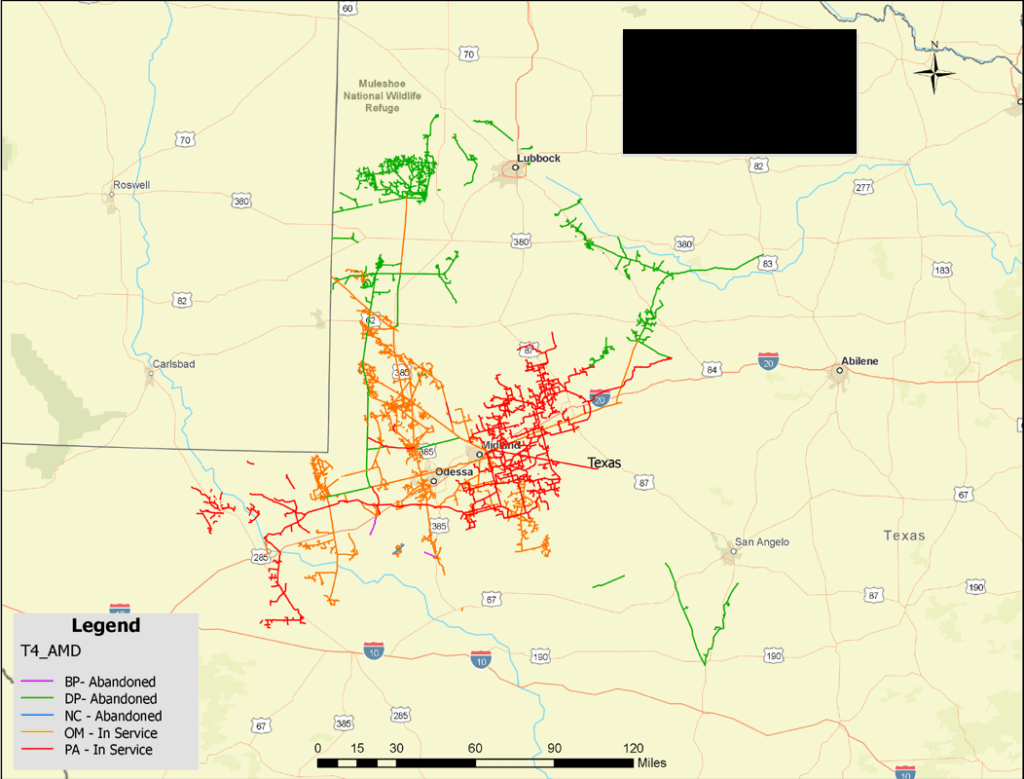
What Changed: A System-Level Reorganization
The filing documents transfers, merges, deletions, abandonments, and technical updates—classic signs of a mature network being re-engineered.
1) Pipeline Additions (PA)
- ~730 miles transferred from another T-4 permit following ownership changes
- ~60 miles of new construction
- ~7.7 miles reclassified from interstate to intrastate
Signal: targeted infill and jurisdictional cleanup, not broad expansion.
2) Merge Permits (MP)
- ~1,150 miles merged from four permits into one system
Signal: administrative simplification and unified operations.
3) Deleted & Divested Pipe (DP)
- ~1,420–1,520 miles transferred out
- ~18 miles physically removed; ~3.7 miles removed as facility piping
Signal: asset rationalization—retiring or divesting pipe that no longer fits flow patterns.
4) Abandoned in Place (BP)
- ~12.6 miles abandoned under state and federal rules
Signal: de-risking redundant or legacy segments.
5) Other Modifications (OM)
- ~2,560 miles updated for subsystem names, diameters, and centerline accuracy
Signal: groundwork for integrity programs, GIS modernization, and future flexibility.
All actions are documented in the RRC Form C-LTR and permit exhibits.
Development Cadence: How This Fits the Bigger Picture
Phase 1 — Asset Control & Jurisdiction (2024–2025)
Transfers, reclassifications, and consolidation establish clear operational control.
Phase 2 — System Optimization (2025)
Merges, deletions, and geometry corrections align pipe with real-world volumes.
Phase 3 — Targeted Growth & Reliability (2025–2026)
Limited new builds and technical upgrades support debottlenecking, compliance, and reliability.
This is manufacturing-style midstream—optimize first, then grow where it matters.
Why the Permian Matters to Energy Transfer
On its recent earnings call, Energy Transfer was explicit: the Permian is a growth engine.
Volumes & Performance
- Permian volumes up ~17% YoY, driven by plant upgrades, new facilities, and the WTG asset.
- Growth in the Permian offset weakness in some dry-gas regions.
Processing & Plants
- Lenorah II (200 MMcf/d): fully utilized
- Badger (200 MMcf/d): ramping
- Mustang Draw:
- Phase I in service Q2 2026
- Mustang Draw II (250 MMcf/d) approved; in service Q4 2026
- ~$260MM total investment including gathering and downstream tie-ins
Result: record processed volumes and Y-grade throughput.
Pipeline Strategy Out of the Basin
- Hugh Brinson Pipeline:
- Phase 1 fully contracted
- Phase 2 adds bidirectional capability (West↔East)
- >90% of Texas cross-haul capacity sold out through 2036, largely Permian-fed.
Optionality: NGL → Natural Gas Conversion
- ET is evaluating converting one Permian NGL line to natural gas.
- Rationale: NGL tariffs are compressing; gas (power + data centers) can deliver ~2× revenue.
- Decision pending—but framed as capital-efficiency optimization.
Power & Data Centers
- Permian gas is increasingly positioned for gas-fired power and data centers.
- Customers are already seeking to lock up Waha supply.
- ET estimates Permian gas must grow 12–15% just to fill announced pipelines over the next ~5 years.
Why This Matters—Especially for Service Companies
- Engineering & Integrity: geometry updates and reclassification often trigger ILI runs, verification surveys, and MAOP reviews.
- Construction & ROW: even modest new mileage in the Permian means complex tie-ins and live-system work.
- Digital & Data Vendors: permit consolidation strongly correlates with GIS cleanup and integrity data modernization.
- Producers: a streamlined common-carrier network reduces takeaway risk and improves commercial optionality.
Bottom Line
RRC T-4 Permit 06776 shows Energy Transfer fine-tuning a massive Permian liquids system—consolidating, correcting, and selectively expanding to match today’s volumes and tomorrow’s demand. Coupled with management’s commentary, the message is clear: the Permian is central to Energy Transfer’s growth story, not a sunset basin.