
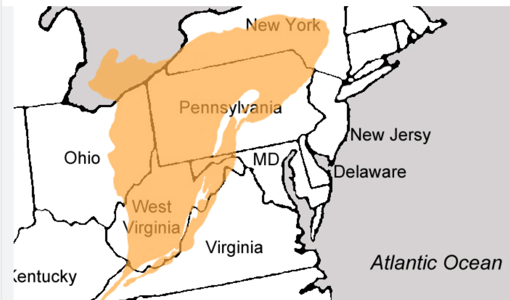
Rig activity across the Marcellus–Utica remains stable, but the distribution of rigs by basin tells a more important story: this is a precision-development gas basin dominated by a small number of core operators, not a broad-based recovery.
Total rigs across the Marcellus–Utica held steady last week at 39, with Pennsylvania, Ohio, and West Virginia each maintaining their relative positions. Beneath that headline number, however, rig concentration by play highlights where capital is truly being deployed.
Pennsylvania Marcellus: EQT Anchors the Basin
In the Marcellus Shale in Pennsylvania, rig activity is led decisively by EQT Corporation, which operates 5 rigs in the current dataset. EQT’s continued presence reinforces its role as the basin’s primary development anchor, executing a steady, factory-style drilling program.
Behind EQT, Expand Energy operates 3 rigs, while Range Resources Corporation runs 2 rigs. The drop-off after the top operator is notable and underscores how concentrated capital allocation remains in the Pennsylvania Marcellus.
Takeaway: Pennsylvania remains the most active Marcellus sub-basin, but growth is tightly controlled and dominated by a single operator.
West Virginia Marcellus: Steady-State Development
West Virginia’s Marcellus rig count reflects a steady-state development model rather than expansion. Antero Resources and CNX Resources each operate 2 rigs, with Arsenal Resources running 1 rig.
This balanced distribution suggests operators are maintaining core acreage positions and advancing inventory methodically, rather than responding aggressively to short-term gas price movements.
Takeaway: West Virginia remains stable and disciplined, serving as a maintenance basin rather than a growth engine.
Ohio Utica: Ascent Continues to Dominate
In the Utica Shale, Ascent Energy leads with 4 rigs, maintaining its long-standing position as the basin’s dominant operator. EOG Resources follows with 3 rigs, while Gulfport Energy operates 2 rigs.
Ohio’s Utica remains the most concentrated of the three sub-basins, with a small number of operators accounting for nearly all active rigs.
Takeaway: The Utica continues to function as a highly selective, operator-controlled development play.
The Bigger Picture
Across the Marcellus–Utica, rig activity remains flat, concentrated, and intentional. Each sub-basin is anchored by one or two dominant operators, reinforcing that capital discipline—not growth—is the governing strategy. This stands in contrast to more volatile gas plays where rig counts are reacting more directly to LNG exposure and pricing signals.
For oilfield services and supply-chain participants, this environment favors targeted engagement with core operators, not broad market coverage. In the Marcellus–Utica, knowing who is drilling matters far more than knowing how many rigs are running.