
As drilling activity across the Permian Basin becomes increasingly concentrated, infrastructure — not geology — is once again shaping where capital flows.
In January 2026, Nile Midstream, LLC received regulatory approval from the Railroad Commission of Texas to operate a new crude oil pipeline system in the heart of the Central Basin Platform. The approval reinforces a broader trend across West Texas: short-haul crude gathering systems are becoming critical enablers of development in mature, high-density oil corridors such as Crane County.
Who Is Nile Midstream
Nile Midstream is a privately held midstream operator headquartered in Fort Worth, Texas, focused on building producer-aligned infrastructure solutions across the Permian Basin.
The company’s strategy centers on:
- Crude oil gathering
- Natural gas gathering and compression
- Produced water transportation and disposal
- Targeted pipeline systems designed for rapid development timelines
Rather than large long-haul projects, Nile’s model emphasizes localized infrastructure — connecting production directly to downstream hubs, existing trunk lines, and market access points.
This approach aligns with today’s Permian development reality, where operational efficiency and cycle time often matter more than basin-wide expansion.
Delta Crude Express Pipeline – Permit Overview
The newly approved system — known as the Delta Crude Express — is a liquid crude oil pipeline authorized under the Railroad Commission’s Pipeline Safety Division.
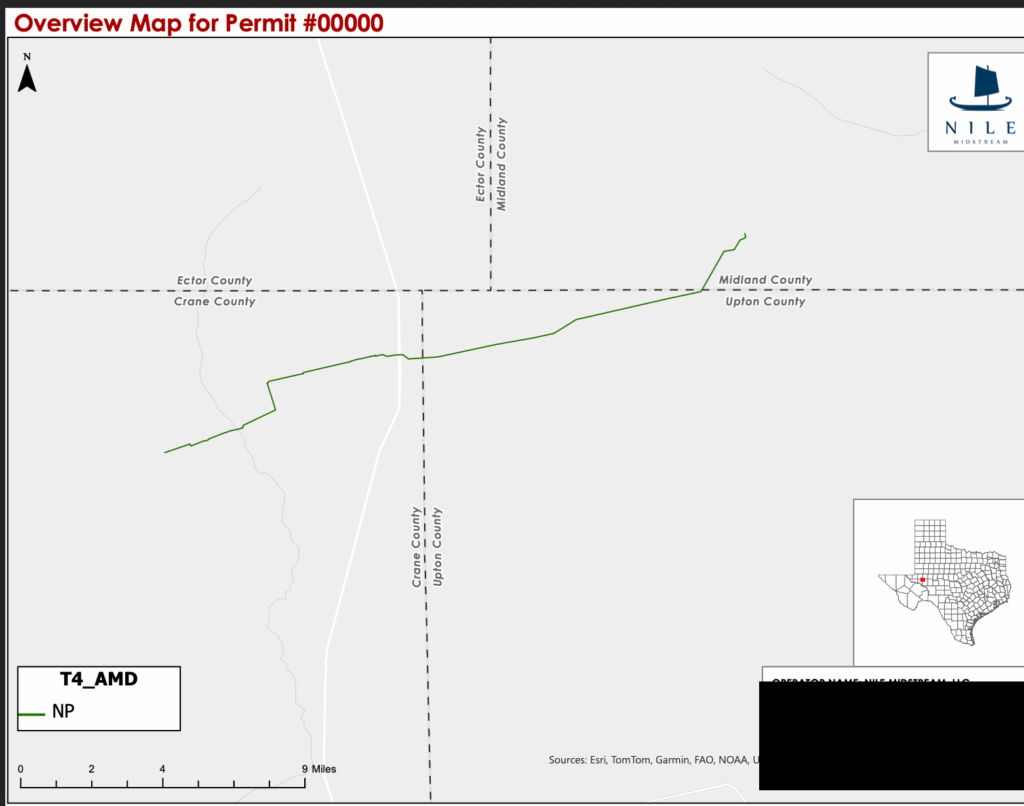
Key permit details include:
- Operator: Nile Midstream, LLC
- Permit Number: 10747
- Approval Date: January 22, 2026
- Permit Valid Through: May 31, 2027
- Commodity: Liquid (Crude Oil)
- Pipeline Classification: Common Carrier
- Total Permitted Mileage: 18.53 miles
- Regulated Miles: 0.00
- Unregulated Miles: 18.53
- System Name: Delta Crude Express
The pipeline is permitted to operate across:
- Crane County
- Upton County
- Midland County
ce37ce449b03cea16225494361e9a91…
The system is fully classified as unregulated crude gathering, consistent with short-distance Permian oil pipelines designed to connect field production with nearby sales points.
Why Crane County Matters
Crane County sits at the core of the Central Basin Platform (CBP) — one of the most economically resilient oil-weighted regions in North America.
Unlike frontier shale plays, the CBP is defined by:
- Dense legacy production
- Extensive stacked pay zones
- High infrastructure saturation
- Lower breakeven economics relative to fringe acreage
Operators in Crane County continue to drill not because it is new — but because it consistently delivers.
This sustained activity has created a persistent need for:
- Additional crude evacuation capacity
- Reduced reliance on trucking
- Short-cycle tie-ins as pad development expands
The approval of the Delta Crude Express pipeline directly addresses these constraints.
Strategic Importance of the Central Basin Platform
While much attention often shifts toward emerging acreage, the Central Basin Platform remains one of the highest-value drilling corridors in the Permian Basin.
Its advantages include:
- Proximity to Midland crude hubs
- Access to multiple downstream takeaway systems
- Predictable production profiles
- Stable drilling programs supported by private and public operators
As consolidation reshapes the Permian, infrastructure investment is increasingly following where rigs remain active, not where acreage is speculative.
The Delta Crude Express pipeline reflects this shift — reinforcing infrastructure in proven counties rather than chasing basin-wide expansion.
What This Approval Signals
From a market perspective, the Nile Midstream permit highlights several important trends:
1. Continued confidence in Permian oil development
Even amid volatile commodity prices, crude infrastructure is still being sanctioned in core counties.
2. Growing importance of short-haul gathering systems
Smaller pipelines are replacing trucks and bridging the final mile between wellhead and market.
3. Infrastructure following execution, not permits
With drilling concentrated among fewer operators, midstream investment is increasingly precise and localized.
4. Crane County remains a priority development zone
Capital continues to flow toward counties with repeatable economics and predictable returns.
Bottom Line
The approval of Nile Midstream’s 18.5-mile Delta Crude Express pipeline underscores the ongoing strength of the Central Basin Platform — and Crane County’s role as a cornerstone of Permian oil production.
As operators focus on capital discipline and execution efficiency, midstream systems like this one provide the quiet but essential backbone that keeps drilling programs moving forward.
In today’s Permian Basin, infrastructure doesn’t chase growth — it enables it.
