
Oklahoma’s oil and gas drilling landscape remains firmly in steady-state mode, according to the latest rig count update from Baker Hughes. For the most recent reporting week, rig counts across Oklahoma’s major plays showed no change, reinforcing a broader theme of capital discipline and predictable execution rather than growth-driven expansion.
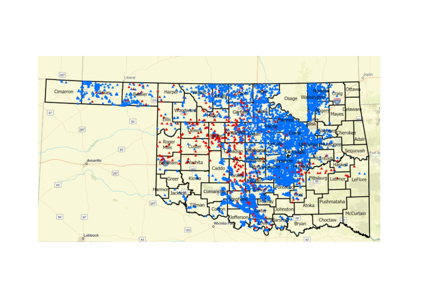
However, drilling activity data from the last 30 days of spud activity confirms where operators are actually putting rigs to work. The data shows that Cana Woodford counties dominate well spuds, highlighting the continued operational focus in the Anadarko Basin’s liquids-rich fairway.
Core plays remain unchanged
Drilling activity continues to be concentrated in a small number of proven plays across Oklahoma:
- Cana-Woodford Shale held steady at 22 rigs, maintaining its position as Oklahoma’s most active oil and gas play.
- Granite Wash followed with 13 rigs, unchanged week over week.
- Ardmore Woodford remained at 2 rigs, while the Arkoma Woodford held at 3 rigs.
- The Mississippian Lime again reported no active drilling, underscoring its sidelined status in the current capital cycle.
The lack of movement across all major plays signals that operators are comfortable with current activity levels. There is no evidence of acceleration, but just as importantly, no sign of pullback.
Top 5 Oklahoma Operators by Rig Count
Activity within the state is driven by a concentrated group of operators. Based on the Oklahoma spud dataset from the last 30 days, the Top 5 Operators by unique rig count are:
Continental Resources — 6 rigs
Rigs: Cactus 170, H&P 544, H&P 548, Latshaw 42, Patterson 272, Patterson 287
Profile: The most active operator in the dataset, running a diversified contractor mix across multiple Anadarko Basin drilling programs.
Mewbourne Oil Company — 4 rigs
Rigs: Patterson 287, Patterson 291, Patterson 564, Patterson 592
Profile: Highly disciplined development strategy relying on a consistent Patterson rig fleet.
Validus Energy — 4 rigs
Rigs: H&P 300, H&P 388, H&P 459, H&P 649
Profile: A single-contractor strategy using Helmerich & Payne rigs, indicating standardized drilling operations.
Camino Natural Resources — 4 rigs
Rigs: Cactus 154, Cactus 160, Cactus 166, Cactus 168
Profile: Clustered rig deployment suggests structured multi-well pad development.
Warwick Energy Group — 2 rigs
Rigs: Cactus 129, Cactus 135
Profile: Smaller program but steady drilling cadence supporting ongoing acreage development.
Spud data confirms Cana corridor drilling
While the rig report reflects where rigs are operating, recent spud activity reveals where wells are actually being drilled. Over the last 30 days, drilling has been heavily concentrated across counties within the Anadarko Basin Cana corridor.
Top Counties by Wells Spud (Last 30 Days)
| County | Wells Spud |
|---|---|
| Grady | 7 |
| Roger Mills | 7 |
| Custer | 7 |
| Canadian | 5 |
| Blaine | 4 |
| Caddo | 3 |
| Pittsburg | 2 |
| Stephens | 2 |
These counties sit squarely within the Cana Woodford and STACK fairway, reinforcing why the play continues to attract the majority of Oklahoma drilling activity.
Oklahoma vs. the national picture
Nationally, rig activity showed modest shifts elsewhere. The Permian Basin added one rig, while other major basins such as the Haynesville Shale, Marcellus Shale, Utica Shale, and Bakken Formation remained flat.
Against that backdrop, Oklahoma stands out as a mature, cash-flow-oriented drilling province, where capital is allocated to defend core acreage and sustain production rather than chase incremental growth.
What this tells us
Oklahoma’s drilling story right now is about stability, not surprise. Operators are sticking to their best rock in the Cana Woodford and surrounding Anadarko Basin plays, leaning on preferred contractors and maintaining a steady development cadence.
In a market where incremental rigs continue to gravitate toward the Permian, Oklahoma remains a reliable, disciplined, and highly predictable oil and gas province, delivering steady drilling activity without the volatility seen in faster-growing basins.