
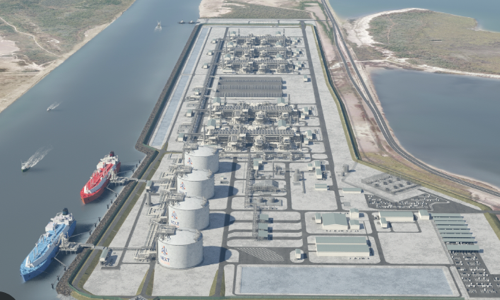
The development of large-scale U.S. LNG export capacity continues to accelerate along the Gulf Coast, with NextDecade’s Rio Grande LNG project emerging as one of the most important terminals under construction today.
Located on the Brownsville Ship Channel in South Texas, Rio Grande LNG is strategically positioned to receive natural gas from some of North America’s most prolific producing regions — particularly the Permian Basin and Eagle Ford Shale — and deliver that supply to global markets.
As LNG demand grows across Europe, Asia, and emerging markets, Rio Grande LNG Phase 1 represents a critical link between U.S. upstream production and international energy security.
Rio Grande LNG & Pipeline Takeaway
One of the key themes highlighted around Rio Grande LNG is improving natural gas takeaway capacity into South Texas and the Gulf Coast.
Pipeline connectivity toward Rio Grande and other LNG export hubs continues to strengthen with new infrastructure projects, including:
- Forza Pipeline
- Traverse Pipeline
These new and expanded pipelines are helping relieve regional bottlenecks and improving flow assurance from the Permian Basin and Eagle Ford, ensuring that growing gas supply can reliably reach export terminals along the coast.
As LNG export capacity expands, pipeline takeaway remains one of the most critical enablers — and Rio Grande LNG sits directly in the path of these improvements.
Project Overview
Developer:
NextDecade Corporation (through its subsidiary, Rio Grande LNG)
Location:
Brownsville Ship Channel, South Texas
Facility Type:
Liquefied Natural Gas (LNG) export terminal
Purpose:
To liquefy and export U.S. natural gas to global markets by cooling it into liquid form, enabling efficient overseas transportation.
The project is designed to monetize abundant U.S. shale gas production while supporting long-term global LNG supply growth.
What Phase 1 Includes
Phase 1 of the Rio Grande LNG project represents the foundation of the full development.
Key components include:
- Three liquefaction trains (Trains 1–3)
- Approximately 18 million tonnes per annum (MTPA) of LNG production capacity
- Supporting storage tanks, marine loading facilities, and associated infrastructure
Construction officially began in July 2023 under an engineering, procurement, and construction (EPC) contract with Bechtel, one of the world’s leading LNG engineering firms.
Expected startup:
- Initial LNG exports targeted around 2027, beginning with the first trains.
Investment and Ownership Structure
A major milestone for the project occurred in July 2023, when Rio Grande LNG reached Final Investment Decision (FID) for Phase 1.
This confirmed that financing was fully secured to proceed with construction of Trains 1–3.
Key stakeholders include:
- TotalEnergies
- Holds approximately 16.7% ownership interest in Phase 1
- Committed to long-term LNG offtake agreements, providing commercial stability
- Global Infrastructure Partners (GIP) and other infrastructure-focused investors supporting development and long-term ownership
The combination of long-term LNG purchase agreements and institutional capital backing has positioned Rio Grande LNG among the most financially secure LNG projects currently under construction in the U.S.
Long-Term Vision and Expansion Potential
While Phase 1 includes three liquefaction trains, Rio Grande LNG was designed with significant expansion capability.
Planned future development includes:
- Additional liquefaction trains (such as Train 4 and Train 5)
- Total site capacity of up to 27 MTPA when fully built out
- Potential for even larger expansions depending on market demand and regulatory approvals
This scalable design gives NextDecade flexibility to align future construction with global LNG market conditions.
Regulatory and Legal Considerations
Like many large U.S. energy infrastructure projects, Rio Grande LNG has faced regulatory and environmental scrutiny.
Key points include:
- Federal court rulings previously questioned aspects of environmental review documentation
- Construction has continued while supplemental analysis is conducted
- The Federal Energy Regulatory Commission (FERC) continues to oversee permitting and environmental compliance through updated Environmental Impact Statements (EIS)
Despite these challenges, Phase 1 construction remains active and ongoing.
Why Rio Grande LNG Matters
Rio Grande LNG Phase 1 is significant for several reasons:
- Adds major U.S. LNG export capacity at a time of rising global demand
- Strengthens U.S. energy security partnerships with Europe and Asia
- Supports Permian and Eagle Ford gas production growth
- Creates thousands of construction jobs and long-term operational employment in South Texas
- Reinforces the Gulf Coast’s position as the world’s most important LNG export corridor
Once operational, Rio Grande LNG is expected to rank among the largest LNG export terminals in the United States, contributing meaningfully to long-term natural gas demand and pipeline utilization.
Bottom Line
Rio Grande LNG Phase 1 represents a pivotal investment in U.S. energy infrastructure.
With:
- 18 MTPA under construction
- Strong commercial backing from global LNG buyers
- Improving pipeline takeaway from the Permian and Eagle Ford
- Expansion potential well beyond initial phases
the project highlights how LNG export growth continues to reshape the North American natural gas market.
As takeaway capacity improves and new pipelines come online, facilities like Rio Grande LNG are becoming critical demand anchors — linking U.S. shale production directly to global energy markets for decades to come.