
Overview
A business system is a defined set of principles, practices and procedures that are applied to specific activities to achieve a specific result. Basically, it’s about creating a set of shortcuts that will make sure everything still gets done right. You can create systems for many areas of your businesses. Oilgasleads has been working with companies over 20 years to help them implement a sales system that delivers an amazing users experience for your sales team and customers. We help companies manage the system with Customer Relationship Management (CRM) software.
The Sales System
The sales system is grouped in three sub-systems that include business development, customer development and customer fulfillment. The entire systems is made up of 11 principles that include networking, prospecting, lead development, account management, opportunity management, quoting, closing, contract, adoption, uptake and activate.
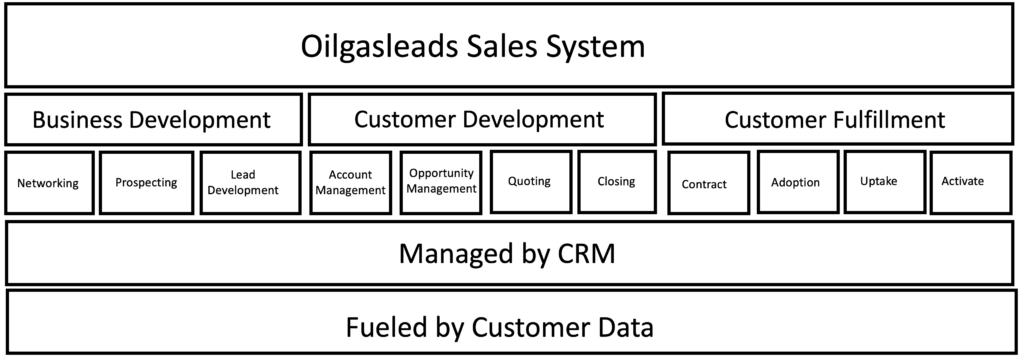
Sales System Details
Business Development (BD)
BD is made up of 3 principles that include prospecting, networking and lead development. Each principle is made up of procedures that are designed to help companies grow business with existing and new customers.
Customer Development (CD)
CD is made up of 4 principles that include Account Development, Opportunity Development, Proposal and Close. Each process is made up of procedures that are designed to manage qualified leads and existing customers. The entire process can be managed within a CRM allowing you to measure the quality of relationship you have with your customers.
Customer Fulfillment (CF)
CF is made up of 4 principles that include Contract, Adoption, Uptake and Acceptance. Each process is made up of procedures that are designed to manage qualified leads and existing customers. The entire process can be managed within a CRM allowing you to measure the quality of your customer delivery.
Data
Everything we do at Oilgasleads is based on helping our customers become data focused organizations. This includes cleaning and enriching customer data to support the systems with highest level of analytics.
Revving Up Your Sales: Why Process, Personalization, and Digital Tools Win Every Time
In today’s market, closing deals isn’t about who has the biggest contact list — it’s about who understands their buyer, adapts fast, and uses technology to their advantage. Entrepreneurs often pour energy into product development, operations, or marketing… but when it comes to sales, many are still running on instinct rather than structure. The result? Missed opportunities, inconsistent results, and unpredictable revenue.
If you’re ready to turn your sales operation into a predictable growth engine, here are three foundational pillars you need to master.
✅ 1. Diagnose Before You Fix: Assess the Current Sales Process
You can’t optimize what you can’t see.
Too many companies operate without a clear map of what actually happens between “lead comes in” and “deal closed.” Start by auditing the steps your team follows today:
- How do you generate leads?
- What happens during initial contact?
- What qualifies someone as a real opportunity?
- What percentage of deals progress from one step to the next?
- How long is your average sales cycle?
These observations give you insight into the friction points your customers experience — and the inefficiencies your team may not even notice. The truth is, most reps follow their own version of the sales process. Standardizing it is the first step in scaling it.
From there, track a handful of meaningful KPIs:
- Meetings-to-calls ratio
- Stage conversion rates
- Year-to-date sales
- Sales per rep
This data isn’t just for reporting — it’s the foundation of accurate forecasting and better strategic decisions.
✅ 2. Modernize Your Approach: Lead Generation Isn’t What It Used to Be
Cold calls aren’t dead, but they’re definitely not enough.
Today’s buyers do most of their research before they ever speak to a salesperson. That means your job is not just to sell — but to educate, influence, and build trust before the buyer is ready to engage.
Two types of lead generation matter:
Demand Capture
These are buyers actively looking for what you offer — usually found via:
- Google search
- Website inquiries
- Paid ads
- Social media
This is the smallest part of the pie.
Demand Generation
This is where long-term revenue is created:
- Sharing insights on LinkedIn
- Speaking at industry events
- Posting videos, case studies, or thought leadership
- Providing valuable information before the buyer needs you
Demand generation helps you earn mindshare early — so when the buyer moves into purchasing mode, you’re already on their radar.
✅ 3. Personalization Wins: Tailored Outreach Builds Trust
Gone are the days of generic messaging.
Research shows B2B buyers spend only 17% of their time meeting with potential suppliers — and if they’re evaluating multiple vendors, each supplier may get as little as 5% of total decision time.
Your window to make an impact is tiny.
Every outreach should reflect:
- The company’s current challenges
- The buyer’s preferred communication style
- Their decision-making structure
- Their industry-specific pain points
- The competitive landscape
A tailored approach shows respect, intelligence, and preparation — and dramatically increases your close rate.
✅ 4. Virtual Selling Isn’t Optional — It’s Your Competitive Edge
Remote meetings aren’t going anywhere.
Buyers are busier than ever, and 30-minute virtual presentations are now the norm. Winning online means:
- Tight, relevant presentations
- Human body language, even over webcam
- Interactivity (not a monologue)
- A clear next step before ending the call
Great sellers know that attention spans online are short — so they lead with value, stay laser-focused, and leave prospects with confidence.
✅ 5. Build a Team That Scales: Hunters + Farmers
The most effective sales teams divide responsibility strategically:
Hunters
- Find new opportunities
- Love chasing big targets
- Thrive on momentum
Farmers
- Manage existing accounts
- Build long-term relationships
- Look for upsell and cross-sell opportunities
When each rep leans into their strengths, revenue accelerates.
✅ 6. Digitize to Scale: Your CRM Is the Engine, Not the Accessory
Today’s top-performing organizations treat their CRM as the single source of truth. A modern CRM ecosystem allows you to:
- Track every lead, opportunity, and customer detail
- Automate follow-ups
- Improve forecasting
- Identify high-value accounts
- Align sales, marketing, and finance
It also integrates with tools like CPQ software, accounting platforms, and digital payment systems — simplifying the entire customer journey.
A CRM isn’t “extra work.” It’s a powerful, centralized data engine that frees your reps from manual tasks and gives leadership real-time insight for strategic decisions.
✅ A Well-Oiled Sales Machine Is Possible
Imagine a team where:
- Hunters bring in new business
- Farmers nurture and expand accounts
- CRMs automate follow-ups
- Leadership has real-time dashboards
- Quotes and invoices are generated in minutes
- Marketing content supports every stage of the funnel
This isn’t hypothetical — it’s how modern sales teams operate every day. With structure, technology, and an aligned strategy, any company can build a scalable, predictable revenue engine.
Related Post
KPIs vs. OKRs: How High-Performing Companies Turn Strategy Into Results