
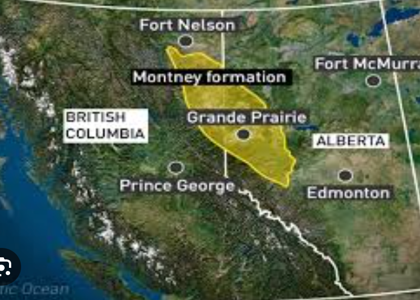
Over the past several quarters, Canada’s largest Montney operators — including ARC Resources, Canadian Natural Resources, Ovintiv, Tourmaline, and others — have delivered a remarkably consistent message.
Not just about production.
Not just about drilling.
But about how the Montney actually works as a long-term supply basin — and why it is becoming one of North America’s most strategically important natural gas regions.
When management teams across competing companies independently repeat the same themes, it’s worth paying attention.
Below are the common threads emerging across operators, and more importantly, why they matter for gas markets, LNG growth, and capital allocation going forward.
1. Inventory Depth Is Measured in Decades — Not Years
Across earnings calls and investor presentations, Montney operators consistently emphasize:
- 15–25+ years of drilling inventory
- Multi-phase development visibility
- Long-duration resource optionality
This is not short-cycle shale behavior.
Unlike mature U.S. basins where inventory quality can vary meaningfully by tier, Montney operators describe deep, repeatable drilling locations across large contiguous land positions.
Why this matters
Long-duration inventory changes how companies think:
- Development is not lease-driven
- Capital can be paced across cycles
- Supply growth becomes controllable, not reactive
In practical terms, the Montney is not running out of drilling locations — it is managing when to use them.
That distinction becomes critical in a world increasingly shaped by long-dated LNG contracts and infrastructure commitments.
2. Land Is an Advantage — Not a Constraint
One of the most important signals from recent calls is what operators did not discuss.
There has been:
- No urgency around land capture
- No lease-expiry pressure
- No “hold-by-production” language
Instead, companies repeatedly emphasize that their acreage is:
- Long-held
- Highly contiguous
- Already de-risked
Land is viewed as strategically secured, not something requiring capital today.
Why this matters
This removes one of the biggest sources of volatility seen in shale basins.
Without lease pressure:
- Drilling responds to economics, not deadlines
- Capital returns can take priority over volume growth
- Activity can pause or accelerate without long-term damage
That flexibility dramatically improves capital discipline — and lowers supply risk for downstream buyers.
3. Infrastructure Control Is as Important as the Resource
Another consistent theme is the integration of land with infrastructure.
Operators repeatedly referenced:
- Company-owned gas plants
- Long-term processing agreements
- Meaningful spare capacity
- Minimal near-term facility capex requirements
This is especially evident in the Montney, where development is often paired directly with:
- Owned gathering systems
- Scalable processing hubs
- Firm transportation agreements
Why this matters
Infrastructure integration creates:
- Predictable development timing
- Lower operating costs
- Reduced midstream bottlenecks
In other words, Montney supply is not theoretical.
It is physically buildable, connectable, and expandable — provided markets exist to absorb the gas.
4. Capital Discipline Has Replaced Volume Growth
Perhaps the most important shift across operators is philosophical.
Montney development is no longer framed around maximizing production growth.
Instead, management teams consistently emphasize:
- Return-based capital allocation
- Free cash flow generation
- Shareholder returns
- Optionality over obligation
Even operators capable of growing volumes meaningfully have been clear:
Growth exists — but growth is not the plan.
Why this matters
This marks a fundamental departure from prior shale cycles.
Supply growth is no longer automatic.
Gas volumes will increase only when:
- Prices justify investment
- Markets exist to absorb molecules
- Infrastructure economics support expansion
This creates a structurally tighter and more rational supply environment.
5. Liquids Strength Enhances Gas Economics
Another unifying theme is the importance of liquids-rich Montney development.
Operators consistently highlighted:
- Condensate pricing near WTI
- Improved well economics from liquids uplift
- Competitive returns even at weak AECO prices
This means Montney gas is often produced:
- Profitably at lower benchmark prices
- As a byproduct of oil-weighted development
- With reduced dependence on Canadian gas pricing alone
Why this matters
Liquids reduce the breakeven cost of supply.
That makes Montney gas:
- More resilient during downturns
- More reliable for long-term export planning
- Less sensitive to short-term AECO volatility
For LNG buyers, this enhances confidence in sustained deliverability.
6. The Real Constraint Is Market Access — Not Geology
When all these themes are viewed together, one conclusion becomes unavoidable:
- Land is abundant
- Inventory is deep
- Drilling efficiency continues to improve
- Infrastructure is largely in place
Yet growth remains constrained.
Why?
Because market access — not supply capability — is the bottleneck.
This was echoed repeatedly through references to:
- AECO exposure reduction
- Firm transport diversification
- LNG-linked pricing structures
- Demand pull from global markets
Operators are effectively saying:
The gas is ready. The basin is ready.
The market is what’s missing.
Why This Matters for LNG
This operator commentary directly underpins the Canadian LNG thesis.
The Montney offers:
- Long-life, scalable gas supply
- Capital-disciplined producers
- Infrastructure-ready development
- Competitive breakevens
- Flexible drilling response
What it lacks is sufficient outlet capacity.
That is precisely what LNG provides.
LNG does not need higher drilling efficiency.
It does not need better geology.
It does not need more land.
It needs takeaway and market connectivity.
Bottom Line
Across Canada’s leading operators, the message is remarkably aligned:
- The Montney is not constrained by land
- It is not constrained by inventory
- It is not constrained by drilling capability
It is constrained by where the gas can go.
That distinction matters enormously.
Because once market access is solved — through LNG terminals, pipelines, and long-term contracts — the Montney is positioned to become one of the most reliable and durable natural gas supply basins in North America.
Not because operators are chasing growth.
But because the system is finally built to support it.
