
The ANTIETAM project in Midland County, Texas offers a clear look into how today’s operators are executing efficient, repeatable development programs in the Permian Basin.
Occidental Petroleum (Oxy) has increasingly positioned its Permian operations around what the industry often describes as a “factory-style development model”—a shift away from exploration-driven drilling toward a system built on standardization, repeatability, and capital efficiency. This approach emphasizes consistent well designs, multi-well pad development, and the integration of centralized infrastructure to optimize performance across entire asset systems.
The ANTIETAM project reflects this strategy in practice.
Rather than a scattered drilling approach, ANTIETAM demonstrates a standardized, pad-driven Spraberry program—one that prioritizes disciplined execution, predictable cadence, and scalable infrastructure. It is not simply a collection of wells, but part of a broader system designed to deliver consistent results across a defined development corridor.
A Pad-Based Development Strategy
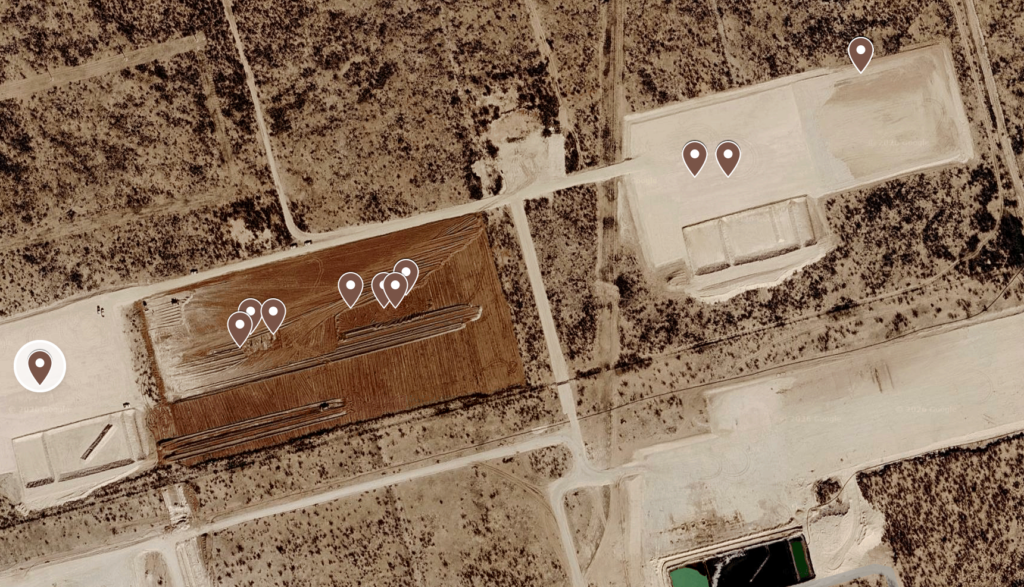
At the surface level, ANTIETAM is structured around multi-well pads, with most activity concentrated in Midland County and a single legacy well in Reeves County.
The project includes:
- 3–6 wells per pad (typical)
- Defined surface grids:
- Block 37T3S / Abstract 927 (Sections 48–49)
- Block 37T2S / Abstract 1237 (Section 1)
- Consistent lease naming (ANTIETAM A–G pattern)
This layout reflects a planned development corridor, not isolated drilling.
👉 Pads are designed and executed as repeatable units, forming the foundation of a scalable drilling program.
One Rig Per Pad: Controlled Execution
Drilling operations at ANTIETAM follow a one-rig-per-pad model, with rigs moving sequentially between pads.
- Citadel 1 drilled the majority of pads
- NorAm 22 was dedicated to a single high-density pad
This approach avoids operational complexity while maintaining efficiency:
- No rig stacking
- No multi-contractor overlap
- Clean execution cycles
👉 A hallmark of a disciplined, mid-scale development strategy
Subsurface: A Pure Spraberry Program
From a subsurface perspective, ANTIETAM is clearly anchored in the Spraberry (Trend Area).
Key subsurface characteristics:
- 100% horizontal wells
- Primary landing zone: ~9,000–9,300 ft
- Occasional deeper targets: ~10,200–11,000 ft
- Tight depth consistency across pads
👉 This is a single-zone development program, not a stacked multi-formation approach.
High-Density Development — Not Co-Development
A key question when evaluating Permian projects is whether the operator is pursuing co-development (multiple formations) or high-density development within a single zone.
The ANTIETAM project clearly aligns with the latter.
Why ANTIETAM is NOT co-development:
- No consistent multi-formation targeting
- No clear Spraberry + Wolfcamp stacking per pad
- Narrow depth ranges within each pad
Why it IS high-density development:
- Multi-well pads (3–6 wells)
- Section-based planning (repeatable grid patterns)
- Consistent landing zone across wells
- Scalable, repeatable architecture
👉 Conclusion:
ANTIETAM represents a high-density, single-zone Spraberry development program, not a co-development strategy.
Development Cadence: Predictable and Repeatable
One of the most important insights from ANTIETAM is the development cadence:
Typical timeline:
- Permit issued
- ~6–9 months → drilling begins
- ~1–4 months → drilling completed
- ~6–8 months → facility permitting
- Production ramp
This cadence is consistent across pads and reflects a manufacturing-style development approach.
Centralized Facilities: Scaling the Development
Rather than building infrastructure per well, ANTIETAM consolidates production through a central facility:
- ANTIETAM Facility 1 (Midland County)
- Standard permit with rapid approval
- Supports multiple pads
👉 Strategy:
Drill → Complete → Centralize → Produce
What ANTIETAM Tells Us About Modern Spraberry Development
ANTIETAM is not an outlier—it’s a blueprint.
Core elements:
- Multi-well pad drilling
- One rig per pad, sequential execution
- Single-zone targeting (Spraberry)
- Tight depth control
- Centralized facility buildout
- Repeatable development cadence
Why This Matters
This type of development signals a shift in the Permian Basin:
From:
Exploration and delineation
To:
Manufacturing and optimization
Operators are:
- Standardizing well designs
- Streamlining drilling operations
- Scaling infrastructure efficiently
Final Takeaway
The ANTIETAM project represents a modern, capital-efficient Spraberry program built on repeatability and control.
It’s a high-density, single-zone development model—not a complex co-development strategy—allowing the operator to maximize recovery while minimizing operational complexity.
👉 In today’s market, that balance defines successful shale development.

Author: phinds