
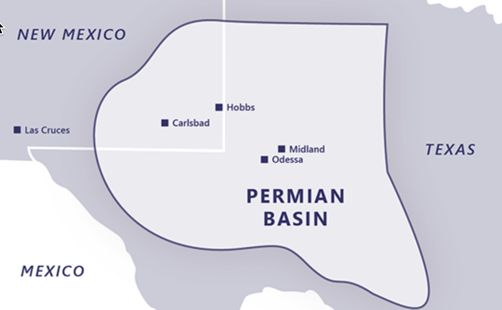
Enverus argues the Permian Basin continues to expand economically despite heavy drilling activity because falling well costs and new interval development are continually replenishing inventory. The report highlights emerging zones like the Barnett-Woodford, growing associated gas importance, and improved development strategies as key reasons the Permian remains the dominant North American oil growth engine.

Here are the major takeaways:
1. The Permian Keeps Replenishing Itself
Despite ~6,000 wells being turned in line annually, the basin’s economically viable inventory has remained roughly flat because:
- Well costs continue to decline
- New intervals are becoming commercial
- Delineation is converting geologically viable acreage into economic acreage
Enverus estimates:
- Economically viable inventory grew ~10% YoY
- The Permian now contains ~55,000 sub-$50/bbl drilling locations
- Total undeveloped inventory approaches 100,000 locations when including geologically viable zones
The report’s core thesis:
“The answer to ‘what’s the next Permian’ is: more Permian.”
2. Interval Expansion Is the Big Story
The largest source of new inventory growth is coming from emerging deeper zones:
- Barnett-Woodford
- Wolfcamp D
- Additional stacked intervals
This is especially important because:
- These zones were not widely considered economic five years ago
- Improved completion techniques and lower costs are changing economics rapidly
The Midland Basin Barnett-Woodford is highlighted as:
- The largest oil-directed expansion opportunity in the Lower 48
- More than 6,000 viable locations identified
- Well performance exceeded Midland averages by 30% in 2025
3. The Permian Dominates Every Other Basin
The report compares the Permian to:
- Eagle Ford
- DJ
- Williston
- Anadarko
- Montney
And concludes the Permian alone has nearly double the sub-$50 inventory of all those plays combined.
Key structural advantages:
- Massive stacked pay
- Continuous interval expansion
- Large-scale infrastructure
- Consolidated acreage ownership
4. Consolidation Has Concentrated Inventory
The top five public operators now control ~70% of the high-quality inventory.
This has several implications:
- Future M&A likely shifts toward public-to-public consolidation
- Remaining private inventory becomes more strategic
- High-quality private acreage is increasingly scarce
The report notes some private operators still control:
- 100+ quality drilling locations
- Competitive breakevens
- Attractive acquisition potential
5. Inventory Quality Depends on Development Sequencing
One of the more technical but important themes is depletion risk.
Enverus argues that:
- Inventory quality cannot be viewed statically
- Parent-child interference matters heavily
- Zone sequencing affects economics dramatically
Examples:
- Lower Wolfcamp zones in parts of the Delaware are vulnerable to depletion from upper zones
- Midland Spraberry recoveries can be cut in half after heavy parent development
This reinforces:
- Simul-frac/full-stack development strategies
- Cube development approaches
- Coordinated interval planning
6. The Yeso Is Quietly One of the Best Economic Plays
A surprising section focuses on the Yeso formation in the Northwest Shelf.
Enverus says:
- Average breakevens are around $39/bbl
- Some areas reach ~$32/bbl
- Economics outperform both Midland and Delaware averages
Why:
- Shallow depths
- Semi-conventional geology
- Lower completion intensity
- Strong liquids yields
Major holders mentioned:
- REPX
- Spur Energy
7. Gas Infrastructure Is Becoming Critical
The report stresses that associated gas economics are increasingly important.
Projected associated gas growth:
- +6.9 Bcf/d by 2030
Key insight:
Some Lower Wolfcamp intervals:
- Are uneconomic at $0 gas
- Become profitable at $2 gas
Meaning:
- Midstream access
- Gas takeaway
- Realized gas pricing
are now central development variables.
The report also notes renewed interest in Alpine High as a gas-driven opportunity.
Strategic Industry Implications
This report supports several broader industry trends:
- The Permian remains the dominant North American oil growth engine
- Consolidation is rational because scale matters more than ever
- Stacked-pay optimization is replacing simple acreage accumulation
- Gas infrastructure and power demand (including AI/data centers) become increasingly tied to oil development economics
- “Peak Permian” predictions continue to get delayed because technology and interval expansion keep adding runway
The report effectively argues that the Permian is evolving from:
- a shale basin
into - a multi-interval manufacturing system with expanding resource depth.

Author: phinds