
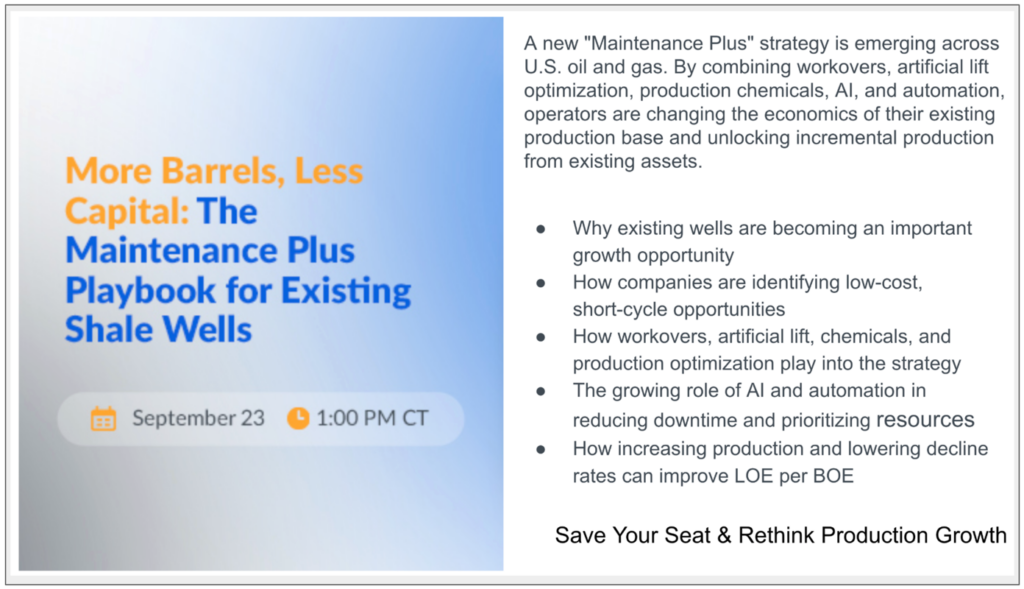
A review of 21 oilfield service (OFS), automation and controls companies shows that suppliers are increasingly aligning around the same production strategy being emphasized by leading U.S. operators: get more value from the existing producing-well base by combining artificial-lift optimization, automation, remote monitoring and proactive maintenance. The companies rarely call this strategy “Maintenance Plus,” but their products and technical resources repeatedly emphasize higher production, lower operating costs, improved uptime and longer equipment life.
Webinar

The strongest examples come from companies with direct artificial-lift technology. Sensia promotes real-time surveillance, remote control, analytics and managing artificially lifted wells “by exception.” SPOC Automation combines variable frequency drives (VFDs), pump-off controls and supervisory control and data acquisition (SCADA) for rod lift, with its current materials emphasizing lower lifting costs, increased production and equipment protection. Puffer-Sweiven offers automated optimization across gas lift and several forms of plunger lift, while Vinson Process Controls provides continuous real-time well optimization with automated adjustments as well conditions change.
The economics are important. SPOC says its IronHorse technology can reduce energy costs by 10–25% while matching rod-pump operation more closely to well inflow. Puffer-Sweiven describes lift optimization as a way to maximize production while reducing equipment wear and costly workovers. Vinson, meanwhile, supports economic gas-lift optimization and automated control designed to continually adjust production as wells decline.
Beyond the artificial-lift specialists, companies such as Automation-X, Klein Automation & Electric, RNB Controls, Mission Controls, Pepperl+Fuchs, Legacy Flow Control, SCS Technologies, Eagle Automation/VanZandt Controls, Dynamic Pressure Control, Setpoint, Ironback, ARPCO, ENGlobal and Intelligent Wellhead Systems extend the opportunity into SCADA, programmable logic controllers (PLCs), instrumentation, communications, motors, VFDs, valve automation, wellsite electrification, reliability and brownfield upgrades. The common theme is an increasingly connected producing asset where operators can monitor → detect → optimize → intervene, rather than relying primarily on scheduled field visits and reactive maintenance. The source review similarly identifies this group as ranging from direct artificial-lift specialists to broader production-automation and Maintenance Plus targets.
What the 21 OFS Companies Are Saying
| Company | What they are saying about Artificial Lift / Maintenance Plus |
|---|---|
| 1. Sensia | One of the clearest confirmations of the thesis. Sensia integrates VSDs, controllers, instrumentation and communications across ESP, SRP and PCP, with remote surveillance and automated gas-lift optimization. Its Avalon platform emphasizes real-time monitoring, acting on problems quickly and moving lift surveillance toward autonomous production and managing wells by exception. |
| 2. SPOC Automation | SPOC’s message is essentially lower lifting cost + increase production + protect equipment. Its IronHorse VFD/POC technology matches rod-pump speed to well inflow instead of repeatedly shutting wells down. SPOC says this reduces energy use, unnecessary maintenance, pump-off events and equipment wear while maximizing production. |
| 3. Puffer-Sweiven | Puffer-Sweiven talks directly about maximizing production from existing oil and gas wells using gas lift, plunger lift, PAGL/GAPL, RTUs and automated optimization. Its technology supports self-adjusting triggers and real-time alerts—essentially moving production from manual surveillance toward automated optimization. |
| 4. Vinson Process Controls | Vinson explicitly talks about continuous real-time well optimization, managing decline curves and automatically adjusting optimization setpoints. Its gas/plunger-lift applications are positioned around higher production, reduced downtime and lower OPEX. A published case study reports a 22-well pilot where automated gas-lift optimization increased crude production 40% while cutting injection gas 50%. |
| 5. Proserv | Proserv sees artificial lift as part of a broader producing-field automation system: RTUs, PLCs, downhole gauges, communications, SCADA, artificial-lift analysis and operations software. It specifically identifies gas lift and ESP systems among its RTU applications and emphasizes remote monitoring and control of widely dispersed assets. |
| 6. Panhandle Lift Solutions | Panhandle is very close to the physical Maintenance Plus model: existing rod-lift pumping units + VFD + POC + load cells + SCADA + inspection/repair. Its VFD/POC systems are positioned around improving production, minimizing operating costs and enabling off-site diagnostics to eliminate downtime and maintenance. |
| 7. Automation-X | Automation-X doesn’t lead with an economic Maintenance Plus slogan, but its product stack enables it: RTUs, PLCs, flow computers, HMIs, instrumentation, communications, valves and importantly plunger control. Its message supports taking field data and control to the wellsite rather than relying solely on manual intervention. |
| 8. Klein Automation & Electric | Klein’s emphasis is oilfield-specific industrial automation, wellsite electrification, SCADA, wireless transmission and data communications. In Maintenance Plus terms, Klein is providing the infrastructure that lets operators remotely monitor and automate an existing producing-well fleet. |
| 9. JEMA Motors & Automation | JEMA’s message centers on motors, VFDs and controls protecting equipment, maximizing efficiency and keeping operations running. Its VFD/control systems can manage individual pumps or larger motor systems, giving it a natural connection to lift-system efficiency and equipment reliability even though it doesn’t market dedicated artificial-lift optimization software. |
| 10. RNB Controls | RNB emphasizes PLC/VFD/pump controls, remote monitoring and easier maintenance. Its design philosophy is particularly Maintenance Plus-friendly: make systems easier to install, commission and service, use VFDs to optimize motor-driven applications and modernize existing systems rather than necessarily replacing everything. |
| 11. Mission Controls & Automation | Mission almost describes Maintenance Plus directly: it asks operators whether they need automation to regulate wells and facilities, analyze production trends, optimize flow and identify problems before they become real problems. PLCs, HMI, flow computers and SCADA are its primary tools. |
| 12. Pepperl+Fuchs | Pepperl+Fuchs approaches the issue from instrumentation and connectivity. Its message is that more field-device data, diagnostics, HART/Remote I/O and condition monitoring allow operators to detect deterioration earlier and move from excessive preventive work toward predictive/proactive maintenance. |
| 13. Legacy Flow Control | Legacy talks strongly about brownfield improvement. It explicitly serves customers replacing existing manual valves or automation packages and says its experience allows it not merely to replace existing equipment but improve it. That’s the surface-production version of Maintenance Plus: retrofit the installed base rather than waiting for greenfield development. |
| 14. SCS Technologies | SCS’s direct artificial-lift connection is weaker, but its production-equipment message is highly relevant: field service for commissioning, maintaining, troubleshooting and repairing measurement and rotating equipment. It also says it wants to lead customers into digitization, automation and AI while reducing cost and improving efficiency. |
| 15. Eagle Automation / VanZandt Controls | VanZandt/Eagle describes itself as a lifecycle provider: design systems, supply instrumentation/controls/communications, install them, then maintain and repair them. Its markets specifically include oil and gas wells, tank batteries, injection wells and production facilities. That’s an excellent fit with keeping the installed asset base operating reliably. |
| 16. Dynamic Pressure Control | DPC comes at Maintenance Plus from the mechanical side: production trees, ESP power feed-through connectors, wellhead equipment, workovers, repairs and maintenance. The message is not automated lift optimization; it’s keep the producing-well/ESP infrastructure serviceable and operating through repair and intervention. |
| 17. Setpoint Integrated Solutions | Setpoint’s focus is reliability—valve automation, instrumentation, repair and service. Its current positioning emphasizes planned and unplanned maintenance, diagnostics and fast repair so equipment can be returned to service safely and efficiently. That aligns very closely with the downtime/reliability portion of Maintenance Plus. |
| 18. Ironback Controls | Ironback explicitly connects instrumentation/electrical maintenance, automation specialists, valve maintenance and plant operations with minimizing downtime and keeping operations running smoothly. It is less directly artificial-lift focused but very strongly aligned with Maintenance Plus reliability. |
| 19. ARPCO Valves & Controls | ARPCO stresses reliability of automated ESD systems, preventative maintenance and operational continuity. Again, this is more surface/wellsite reliability than lift optimization, but its message is that automated equipment must be maintained so failures do not create shutdowns or extended production interruptions. |
| 20. ENGlobal | ENGlobal positions automation as a way to improve production quality, yield, availability and reliability, using PLC/HMI/DCS programming, IIoT, control-system integration and retrofits. It has wellhead-to-refinery experience, so the Maintenance Plus connection is primarily modernization of existing controls and production infrastructure. |
| 21. Intelligent Wellhead Systems | IWS strongly advocates automation, remote operations and data-driven decision-making, but mostly in completions rather than artificial lift. Its current message is nevertheless similar: reduce operating cost and personnel exposure while maintaining visibility, automation and control, and use real-time data to identify operational problems proactively. |
Industry Impact
For North American oil and gas, this strengthens the case for the U.S. as a “Safe Barrel”: a large, established producing base where incremental barrels can come not only from additional drilling, but from improving the performance of wells already online. Artificial-lift optimization, automation and predictive maintenance can help operators protect base production, reduce downtime and improve operating economics without depending exclusively on new-well capital. The OFS supply chain is increasingly building the technology needed to support that model.
OFS Sales Strategy
The sales trigger is therefore changing. Automation and artificial-lift suppliers should look beyond “Who is drilling?” and increasingly ask “Who has the producing wells?” Priority accounts should include operators with large rod-lift, electric submersible pump (ESP), progressive cavity pump (PCP), gas-lift and plunger-lift inventories—particularly mature fields where reducing lease operating expense (LOE), workovers and downtime can materially affect production economics.
For OilGasLeads, that creates a clear intelligence opportunity:
Producing-well inventory → lift method → mature assets → optimization need → Maintenance Plus spending → Production/Artificial Lift/Automation decision-makers.
Two-Sentence Summary
Twenty-one OFS and automation companies are increasingly selling technology around the same Maintenance Plus priorities being discussed by operators: maximize existing production, reduce downtime and LOE, protect equipment, and automate well surveillance and optimization. The trend suggests the next artificial-lift sales opportunity is increasingly tied to identifying operators with large producing-well inventories, not simply those running the most drilling rigs.


Author: phinds