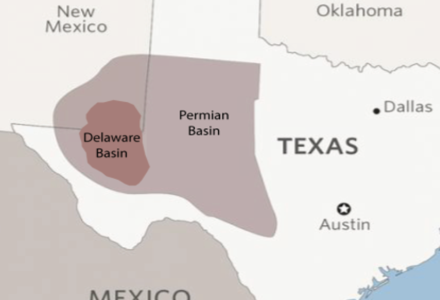
The Delaware Basin has long been one of North America’s most active oil and gas regions. But as the basin matures, a clear shift is underway—from rapid growth and land grabs to disciplined, repeatable development programs.
At the center of this evolution is a distinct group of companies: Steady State Operators.
These are not necessarily the fastest-growing operators, nor the most aggressive. Instead, they are the most consistent, capital-efficient, and operationally reliable players in the basin—and increasingly, they define the direction of the market.
Steady State Operators
What Is a “Steady State Operator”?
A Steady State Operator is characterized by consistent performance across three core areas:
1. Consistency of Operations
- Active, ongoing rig deployment
- Continuous drilling across multiple years (2025 and 2026)
- No sharp spikes or drop-offs in activity
These operators run multi-rig programs with long-term visibility, rather than reacting to short-term commodity price swings.
2. Sustained Permit Flow
- Regular permitting activity over:
- The past 60 days
- The past 12 months
- Multi-year periods
This reflects structured development planning, where permits are continuously replenished to support future drilling.
3. Programmatic Development Behavior
- Balanced performance across:
- Wells drilled
- Rig activity
- Permitting
Rather than relying on a single surge (e.g., a spike in permits), these operators demonstrate repeatable, capital-backed drilling programs.
The Leading Steady State Operators in the Delaware Basin
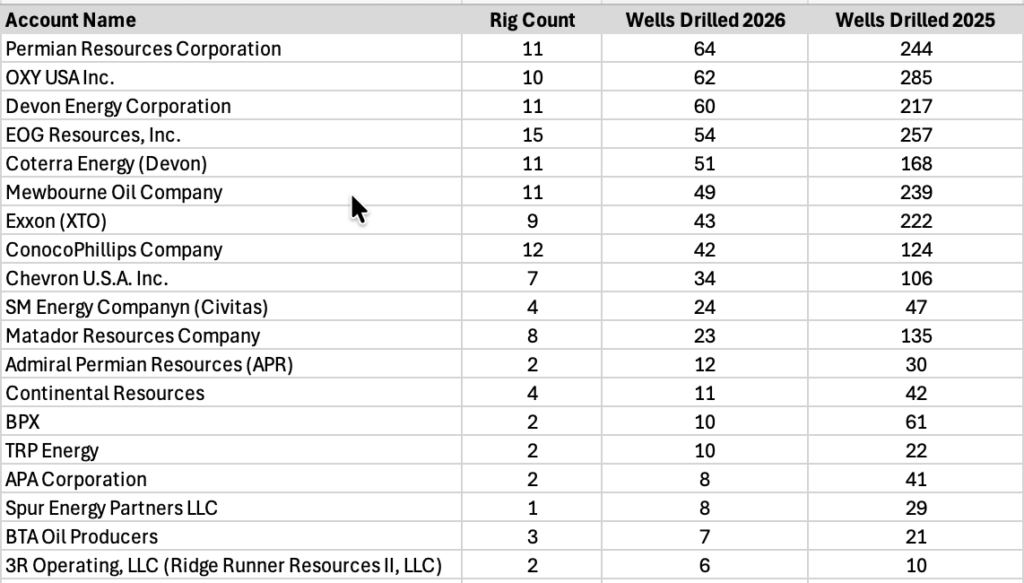
The top tier includes a mix of majors, large independents, and well-capitalized private companies:
- Devon Energy
- Permian Resources
- Occidental (OXY)
- EOG Resources
- Coterra Energy
- Mewbourne Oil
- ExxonMobil (XTO)
- ConocoPhillips
- Chevron
- Matador Resources
Key Insight:
Steady state behavior is not determined by size—it’s driven by operating philosophy and capital discipline.
What the Data Shows
Across these operators, a consistent pattern emerges:
- Strong multi-year drilling activity
- High well counts in 2025
- Continued momentum into 2026
- Sustained rig deployment
- Multi-rig programs maintained over time
- Continuous permitting pipelines
- No reliance on short-term bursts
This signals a shift toward manufacturing-style shale development, where drilling becomes a repeatable process rather than an opportunistic activity.
Why This Matters: The Rise of “Permian 2.0”
The Delaware Basin is entering a new phase—often referred to as Permian 2.0—defined by:
- Capital discipline over growth
- Free cash flow generation
- Inventory optimization
- Operational efficiency
Steady State Operators are leading this transition.
They are no longer chasing aggressive production growth. Instead, they are focused on:
- Maximizing returns
- Extending inventory life
- Improving cost per well
Commercial Implications for Service Companies
For oilfield service providers, these operators represent the highest-quality customer segment in the basin.
Why they matter:
- Predictable activity = predictable revenue
- Long-term development programs enable multi-year contracts
- Lower customer churn compared to smaller, volatile operators
Ideal offerings:
- Drilling optimization tools
- Digital solutions (e.g., DDR automation, geosteering software)
- Consumables (fuel, water, sand, chemicals)
- Efficiency-focused services
How to Sell to Steady State Operators
The biggest mistake? Treating them like growth-stage operators.
Avoid messaging like:
- “We help you scale faster”
- “We help you ramp activity”
Instead, focus on:
- Reducing cost per well
- Improving operational efficiency
- Standardizing workflows
- Enhancing repeatability
These operators are already scaled—they care about optimization, not expansion.
The Bottom Line
Steady State Operators are the backbone of the Delaware Basin.
They represent:
- The most reliable drilling activity
- The most disciplined capital deployment
- The strongest long-term commercial opportunities
As the basin matures, these operators will increasingly define:
- Service demand
- Technology adoption
- The pace of development
For anyone involved in oil and gas—whether in operations, technology, or sales—understanding and targeting this group is no longer optional.
It’s essential.

Author: phinds