
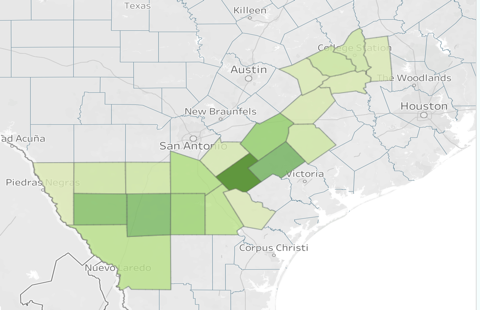
The Eagle Ford remains one of the largest and most commercially important shale markets in the United States, but the latest operator activity data points to something more significant: development activity may be accelerating.
A comparison of account, drilling rig, wells drilled, and permit data across nine major U.S. shale basins shows the Eagle Ford standing out as one of the strongest markets for recent permitting activity.
For oilfield service companies, equipment suppliers, technology providers, and other companies selling into upstream operations, that makes the Eagle Ford an important market to watch—and potentially one of the better places to focus near-term business development efforts.

Eagle Ford by the numbers
The Eagle Ford Account Report currently includes:
Metric Eagle Ford Operator Accounts 152 Active Rigs 59 Wells Drilled in 2026 665 Permits – Last 12 Months 517 Permits – Last 60 Days 184 Recent Permit Trend* 2.14×
*Last-60-day permit pace annualized versus trailing 12-month permits.
The most interesting number may be the 184 permits issued during the last 60 days.
Compared with 517 permits over the trailing 12 months, the recent 60-day activity represents an annualized permitting pace approximately 2.14 times the previous 12-month rate.
Among the nine shale markets reviewed, Eagle Ford shows the strongest recent permit acceleration.
That doesn’t guarantee that every new permit will immediately become a drilling project. But permits are an important forward-looking activity signal and can help sales teams identify operators that may be preparing for future development.
Eagle Ford combines scale with activity
The Eagle Ford is not a small market experiencing a temporary increase in permits.
The account report identifies 152 operators, making it one of the larger operator universes among the shale plays reviewed.
Those operators have already drilled 665 wells in 2026, supported by 59 active rigs.
Only the Permian reports more wells drilled among the nine basins in the comparison.
This combination is commercially important.
A basin can have a large historical operator universe but relatively little current activity. Conversely, a smaller basin can have substantial activity concentrated among only a handful of companies.
Eagle Ford offers something in between: a sizeable account universe, significant current drilling activity, and accelerating recent permitting.
That creates opportunities for both strategic account selling and broader prospecting.
Who is drilling in the Eagle Ford?
The leading Eagle Ford operators by wells drilled in 2026 include:
- ConocoPhillips — 112 wells
- EOG — 81 wells
- Crescent Energy — 52 wells
- Warwick Energy — 34 wells
- Magnolia/WildFire — 31 wells
This mix illustrates another attractive characteristic of the Eagle Ford market.
Activity isn’t limited exclusively to supermajors.
Large public operators sit alongside mid-sized and independent producers, creating multiple potential entry points for companies selling into drilling and production operations.
For a smaller oilfield service company, winning business from the largest operators may involve lengthy vendor qualification processes and established national contracts.
Mid-sized and independent operators can sometimes provide a more accessible path into a basin.
That makes account prioritization particularly important.
Permits can help identify the next sales opportunity
Traditional oilfield prospecting often starts with the rig count.
A salesperson sees a rig operating and begins trying to determine who is drilling, which contractors are involved, and what services might be required.
But by that point, many purchasing decisions may already have been made.
Permit activity provides an opportunity to move further upstream in the sales cycle.
A new permit can indicate that an operator is moving toward future development. When combined with historical drilling activity, current rigs, and operator classification, permits can help identify companies worth researching before drilling begins.
A practical Eagle Ford prospecting workflow might look like:
Recent permits → operator activity → wells drilled → active rigs → account contacts → sales outreach
Instead of asking:
“Who operates in the Eagle Ford?”
the more useful question becomes:
“Which Eagle Ford operators appear most likely to generate sales opportunities next?”
That is a very different use of operator data.
Not every Eagle Ford operator should receive the same sales priority
One of the biggest problems with traditional oil and gas operator directories is that every company tends to look equally important.
They aren’t.
Some operators are running continuous drilling programs. Others may be ramping activity. Some maintain assets but have limited current development, while others may represent legacy operations with little immediate sales potential.
The Eagle Ford Account List helps address this by organizing operators into activity classifications such as:
Steady State — operators demonstrating ongoing activity and generally deserving the highest sales priority.
Next Tier — operators that may represent emerging or developing opportunities.
Dormant / Legacy — companies useful for understanding the complete market but typically lower-priority targets for immediate prospecting.
For sales teams, this distinction can dramatically reduce wasted prospecting time.
Instead of working alphabetically through 152 operators, teams can focus first on companies showing the strongest combination of recent permits, active rigs, and wells drilled.
The Eagle Ford also supports cross-basin selling
Many of the companies operating in the Eagle Ford also operate elsewhere.
Across the nine shale basin account lists reviewed, 149 operators appear in more than one basin.
Several major operators have particularly broad footprints. Devon, EOG, and Exxon/XTO each appear in eight of the nine basin lists, while OXY appears in six and ConocoPhillips in five.
This creates another important sales strategy: land and expand.
If a supplier already works with an operator in the Permian, for example, identifying that company’s Eagle Ford activity can create an opportunity to expand the relationship.
Existing customer relationships, approved vendor status, operational experience, and internal references may provide an advantage over approaching an entirely new account.
For suppliers serving multiple shale markets, understanding where the same operator is active across different basins can therefore be just as valuable as discovering new accounts.
What the data means for oilfield sales teams
The Eagle Ford numbers reinforce an important principle about oil and gas sales intelligence:
The goal shouldn’t simply be to find operators. The goal should be to prioritize operators based on activity.
There are hundreds of databases and directories containing oil and gas company names.
The more valuable intelligence is knowing:
- Which companies are actively drilling?
- Which operators have drilled wells this year?
- Who has rigs running today?
- Which companies have recently received permits?
- Which operators appear to be increasing activity?
- Which accounts should salespeople work first?
For the Eagle Ford, the recent permitting data provides a particularly useful prospecting signal.
With 184 permits in the last 60 days, 665 wells drilled in 2026, 59 active rigs, and 152 operator accounts, the basin offers both scale and forward activity.
From account discovery to account prioritization
Oilfield sales teams don’t necessarily need more company names.
They need a better way to determine which companies deserve attention right now.
The Eagle Ford Account List is designed around that idea by combining the operator universe with drilling, rig, and permit intelligence that can help turn a static account list into an actionable prospecting tool.
And based on recent permitting activity, Eagle Ford is one of the U.S. shale markets sales teams should be paying particularly close attention to right now.
Eagle Ford Operator Account List
Explore Eagle Ford operators and prioritize prospects using current drilling, rig, well, and permit activity.
Use the data to identify active operators, spot emerging drilling programs, build target account lists, and focus sales efforts on the companies most likely to generate opportunities.


Author: phinds