
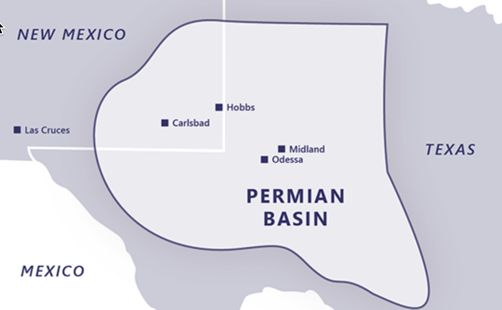
The Permian Basin continues to solidify its position as the most resilient and economically attractive oil play in North America, with new analysis from Enverus Intelligence Research (EIR) highlighting a growing inventory of low-cost drilling opportunities.
In its latest report, “Permian Basin Play Fundamentals: The Intervals Keep Coming,” Enverus estimates there are now approximately 55,000 drilling locations in the Permian Basin that are economic at sub-$50 per barrel oil prices. That represents a 10% increase from last year, driven by a combination of high-quality resource expansion and ongoing cost reductions.
Expanding Inventory Extends the Permian Runway
When including all geologically viable resources—not just those currently economic—Enverus estimates the Permian’s total undeveloped inventory approaches 100,000 drilling locations. This highlights the basin’s long-term depth and its ability to remain competitive even in lower commodity price environments.
According to Stephen Sagriff, Director of Oil and Gas Research at Enverus and author of the report, the key driver behind this growth is the increasing importance of interval optionality.
“Our latest work on the Permian underscores how interval optionality and cost reductions continue to refresh the basin’s runway,” said Sagriff. “Emerging deep zones and development sequencing considerations are increasingly important for understanding where economics hold and where risk may rise.”
In practical terms, operators are unlocking new zones and optimizing development strategies across stacked formations, allowing them to extract more value from existing acreage.
Deeper Zones and Development Complexity
While the increase in economically viable locations is a positive signal, the report also points to growing complexity in basin development.
As operators expand into deeper intervals and revisit maturing core areas, understanding the interplay between geology, well spacing, and sequencing becomes more critical. These factors will ultimately determine where the next wave of high-return drilling occurs—and where risks begin to rise.
This shift marks an evolution in the Permian from a high-growth shale play to a more technically driven, optimization-focused development model.
Private Operators Hold Meaningful Share
Another key takeaway from the report is the role of private operators. Enverus estimates that private companies control approximately 16% of the Permian’s sub-$50 breakeven inventory.
This suggests that a meaningful portion of high-quality, low-cost drilling opportunities remains outside the hands of public operators, potentially setting the stage for continued consolidation or partnership activity.
Barnett-Woodford Emerges as a Key Growth Zone
One of the most notable findings is the emergence of the Barnett-Woodford interval in the Midland Basin as a major expansion opportunity.
Enverus identifies this zone as the largest oil-directed growth opportunity in the Lower 48, with more than 6,000 potential drilling locations.
This highlights a broader trend across the Permian: as traditional zones mature, operators are increasingly turning to previously underdeveloped or deeper intervals to drive future production growth.
What This Means for the Market
The expansion of sub-$50 drilling inventory reinforces several key themes shaping the oil and gas industry:
- Cost discipline is paying off, allowing operators to remain profitable in lower price environments
- The Permian Basin continues to offer long-term development visibility unmatched by other plays
- Technical innovation and geological understanding are becoming as important as acreage quality
- Emerging zones like the Barnett-Woodford could drive the next phase of Permian growth
For service companies, investors, and operators alike, the message is clear: the Permian is far from running out of runway—but the next phase of development will require smarter, more precise execution.

Author: phinds