

Texas GulfLink LLC, an affiliate of Dallas-based Sentinel Midstream LLC, is developing a large-scale crude oil export system connecting the Houston-area pipeline market with a new offshore terminal near Freeport, Texas. The project is designed to load Very Large Crude Carriers directly offshore, avoiding the smaller-vessel “reverse lightering” process commonly used along the Gulf Coast.

The newly permitted 51.69-mile Texas pipeline appears to represent the project’s inbound supply connection from the Webster/Houston market to Texas GulfLink’s planned onshore terminal near Jones Creek in Brazoria County. The route crosses Harris, Galveston and Brazoria counties. Texas GulfLink says this supply pipeline will be 36 inches in diameter, capable of transporting up to 60,000 barrels per hour, and constructed along existing pipeline rights-of-way for approximately 95% of its route.
Pipeline Map
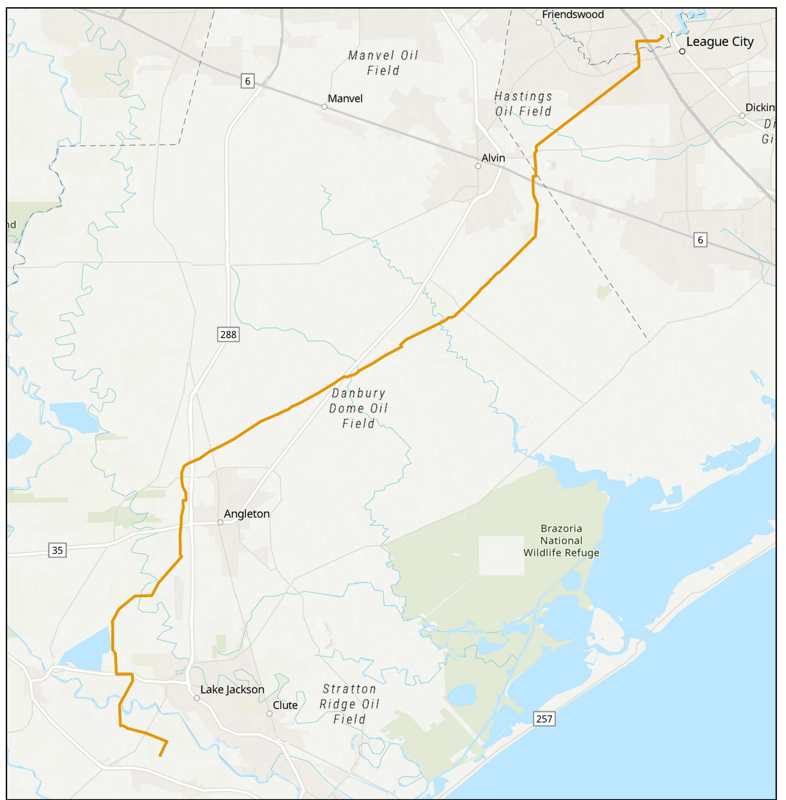
At Jones Creek, the crude oil will enter an onshore storage and pumping complex containing as many as 12 geodesic-dome storage tanks. Each tank is designed with approximately 755,379 barrels of shell capacity, potentially providing more than nine million barrels of total storage if all twelve tanks are installed. Five electric pumps and a continuously staffed operations center will manage movements through the system.
From the Jones Creek terminal, a separate 42-inch crude oil pipeline will run approximately 12 miles over land and another 32.5 miles offshore to a fixed platform. The offshore pipeline will generally be buried three to five feet beneath the seabed—and at least ten feet beneath shipping fairways—and protected with a concrete coating.
The offshore terminal will be located approximately 30 miles off the coast west of Freeport in roughly 105 feet of water. Its principal components will include:
- Two catenary anchor leg mooring single-point mooring buoys
- A permanently staffed offshore platform
- Custody-transfer metering and automatic sampling equipment
- Surge-relief and emergency-response systems
- Floating loading hoses and dedicated support vessels
- Vessel-based vapor-recovery equipment
Each offshore berth will accommodate VLCCs carrying approximately two million barrels. The loading system is designed for rates of up to 85,000 barrels per hour, allowing a VLCC to be loaded in roughly 24 hours. Texas GulfLink estimates that the two-buoy terminal could serve approximately 15 VLCCs per month or 183 vessels annually.
Development Status
Texas GulfLink submitted its federal deepwater-port application to the Maritime Administration and U.S. Coast Guard in May 2019. MARAD issued a favorable Record of Decision in February 2025 following completion of the federal environmental and technical review.
According to Sentinel Midstream:
- The project received its federal deepwater-port license on January 29, 2026.
- Sentinel announced its final investment decision on May 4, 2026.
- Construction activities began immediately afterward.
- Operational startup is targeted for 2028.
- Development is being supported through funding associated with the U.S.–Japan Trade Agreement.
Sentinel will oversee construction, commercial operations and long-term management of the terminal. The company announced formal commencement of the project on May 5, 2026.
Commercial Significance
Texas GulfLink is intended to provide producers and shippers with a direct export path from the Houston crude oil market to customers in Asia, Europe and other international markets. By loading VLCCs directly offshore, the project is expected to reduce transportation costs, lessen congestion in Gulf Coast ship channels and reduce emissions associated with repeated lightering trips.
The September 2026 issuance of Texas RRC Permit 10803 for the 51.69-mile liquid common-carrier pipeline is therefore an important enabling step for the project. It establishes the regulated intrastate connection needed to move crude oil from the Houston/Webster pipeline network to the Jones Creek storage terminal, where it can enter the project’s offshore export system.
Project Summary — Texas GulfLink LLC New Texas Pipeline Permit
- Operator/Owner: Texas GulfLink LLC
- RRC P-5 Number: 846435
- New T-4 Permit: 10803
- Replaced Permit: None identified; issued as a new permit (Amendment Code NP)
- Permit Approval Date: September 10, 2026
- Permit Expiration: June 30, 2028
- Commodity: Liquid
- Classification: Common carrier
- System Type: Other (Code O)
- Pipeline Mileage: 51.69 regulated miles
- Counties: Brazoria, Galveston and Harris counties, Texas
- Region/Play: Texas Gulf Coast, extending from the Lake Jackson/Freeport area through Brazoria County toward Webster and the greater Houston area
- Operator, Economic Operator and Owner: Texas GulfLink LLC


Author: phinds