
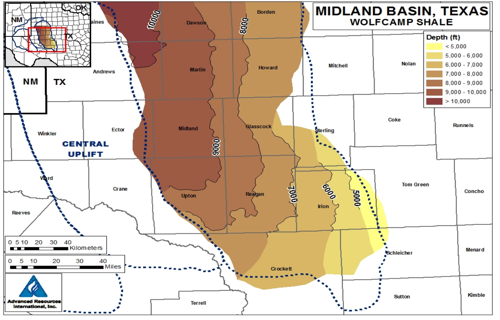
During its latest earnings call, Diamondback Energy, Inc. revealed one of the most important strategic developments in the Permian Basin in years — the quiet buildout of a large drilling inventory targeting the deeper Barnett Shale beneath its Midland Basin acreage.
At the same time, midstream infrastructure is expanding to support future gas volumes. A recent air permit filing by Energy Transfer LP for the Paloma Compressor Station in Ector County signals that midstream companies are preparing for increased natural gas production in the region.
When viewed together with a large inventory of undrilled Barnett permits in Ector County, these developments suggest the basin may be entering the next phase of stacked resource development.
Diamondback Reveals a Major Barnett Resource Position
During the call, Diamondback management disclosed that the company has quietly assembled a substantial Barnett position beneath its Midland Basin acreage.
The company estimates roughly 900 gross drilling locations targeting the Barnett interval. Importantly, this inventory was not built through a large acquisition. Instead, Diamondback accumulated the position gradually over several years through leasing and acreage consolidation.
Management indicated the strategy was intentional. The company preferred to develop and test the resource quietly before publicly discussing the opportunity.
The Barnett lies thousands of feet below the conventional Permian targets such as Wolfcamp and Spraberry. If economic at scale, it effectively adds another full development layer beneath existing Permian drilling programs.
Development Begins in 2026 and Accelerates in 2027
Diamondback outlined a staged development timeline.
In 2026, the company plans to drill approximately 30 wells and complete around 10 wells, focusing on delineation and technical evaluation.
Beginning in 2027, activity is expected to ramp significantly, potentially reaching about 100 wells per year on a gross basis.
This approach mirrors the development pattern seen in many shale plays:
- Initial delineation wells
- Spacing and completion testing
- Transition into large-scale manufacturing-style development
If the early wells confirm expectations, the Barnett could become a long-term drilling engine beneath existing Permian acreage.
Early Results Suggest Strong Productivity
Management noted that early test wells have produced encouraging results.
Estimated recovery comparisons discussed during the call suggest:
- Midland core zones: roughly 50 barrels of oil per lateral foot
- Barnett wells: approximately 75 barrels of oil per lateral foot
If these early results hold across a broader development area, Barnett wells could deliver significantly higher recoveries per foot of lateral than current Midland Basin targets.
Costs are currently higher — roughly $1,000 per lateral foot versus about $520 in the core Midland Basin — but the company expects costs to fall as operations transition to longer laterals, multi-well pad drilling, and simul-frac completion techniques.
Barnett Development Will Increase Gas Production
One key difference between Barnett wells and Diamondback’s core oil zones is the production mix.
Typical Midland Basin wells produce roughly 80% oil initially, while Barnett wells are expected to produce closer to 67% oil, with a larger natural gas component.
That higher gas output could have significant implications for regional infrastructure demand.
As deeper zones like the Barnett are developed, associated gas production across the Midland Basin will likely increase, requiring additional gathering, compression, and processing capacity.
Midstream Expansion Appears to Be Preparing for That Growth
A recent air permit filing with the Texas Commission on Environmental Quality shows that Energy Transfer is registering a new facility known as the Paloma Compressor Station in Ector County near Odessa, Texas.
Compressor stations play a critical role in natural gas gathering systems. They increase gas pressure so that production from well sites can move through pipelines toward processing plants and downstream markets.
The Paloma station is located south of Interstate 20 along County Road 338, an area surrounded by active Midland Basin development.
Although small on its own, infrastructure like this typically forms part of a much larger gathering network that feeds major processing plants such as Energy Transfer’s Mustang Draw gas processing complex.
The timing of the permit suggests midstream operators are continuing to expand infrastructure in anticipation of future gas volumes from the basin.
Ector County Shows a Large Inventory of Barnett Permits
Permit data from Ector County also points toward growing interest in the Barnett interval.
The dataset includes dozens of Barnett-targeted wells across the current year and the previous two years, with only a portion drilled so far.
A large number of permits remain open and undrilled, indicating operators have already secured significant future drilling inventory.
This type of permit backlog is typical when companies:
- secure drilling rights early
- evaluate early well performance
- prepare for larger-scale pad development
The pattern suggests companies are positioning acreage for future development rather than immediate drilling.
The Next Phase of Permian Development
Taken together, three signals point to the same conclusion:
- Diamondback has identified a large Barnett drilling inventory.
- Midstream companies like Energy Transfer are expanding gas infrastructure.
- Ector County contains a significant backlog of Barnett drilling permits.
These developments suggest the Permian Basin may be entering another stage of stacked resource development.
Just as the Wolfcamp and Spraberry transformed the basin over the past decade, deeper intervals like the Barnett could extend drilling inventory and production growth for many years to come.

Author: phinds