
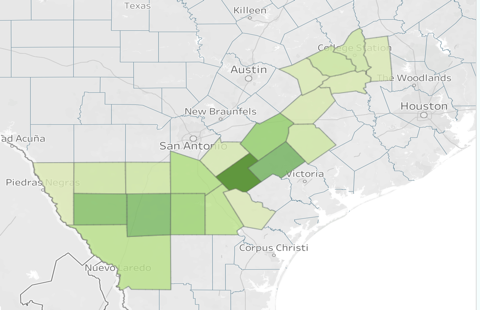
The overall message from the operators is surprisingly bullish on the Eagle Ford and South Texas. Rather than treating the basin as a mature asset to simply harvest, operators are using a combination of selective drilling, technology, acquisitions and optimization of existing production to generate attractive returns and incremental production.

- Eagle Ford remains highly competitive for capital. EOG, Murphy and others emphasized strong returns, fast payouts, existing infrastructure and improving well economics. Murphy is adding $70 million of Eagle Ford capital in 2026 and accelerating drilling into Q4, describing the asset as a reliable source of oily production and free cash flow.
- Operators continue to drive drilling and completion costs lower. EOG’s Eagle Ford direct well costs have fallen below $525/ft, its lowest ever, while drilling feet/day increased 4% and completed lateral feet/day increased 11%. It also drilled a 24,115-foot lateral, which it described as the longest Eagle Ford lateral to date.
- Technology is extending the value of mature acreage. ConocoPhillips is using real-time frac diagnostics and far-field diverters to reduce frac interference and improve recovery. The broader objective is to increase recovery while reducing capital required per barrel.
- Maintenance Plus is becoming important. Crescent is optimizing workovers, ESPs, artificial lift, chemicals, power, compression and lease-operator routes across its producing-well population. Technology allows Crescent to evaluate thousands of wells simultaneously and identify interventions capable of generating immediate production improvements.
- Austin Chalk is expanding the South Texas opportunity. EOG has identified a new Lavaca County Austin Chalk sweet spot with roughly 125 remaining 2-mile locations, while Crescent expects its South Texas drilling mix to reach approximately 50% Eagle Ford / 50% Austin Chalk by year-end 2026.
- M&A is creating larger development platforms. Magnolia’s $4.06 billion WildFire acquisition adds roughly 810,000 net acres and 53,000 BOE/d, creating a combined position of more than 1.25 million net acres with Eagle Ford, Austin Chalk and Woodbine potential.
Key Takeaway
The Eagle Ford is increasingly looking like a “safe barrel” basin: established infrastructure, known geology, large existing well populations and improving operating efficiency allow operators to put capital to work relatively quickly and generate incremental production and cash flow.
Importantly, the strategy isn’t simply “drill more wells.” Operators are simultaneously pursuing longer laterals, better completions, workovers, artificial-lift optimization, chemicals, automation/technology, compression optimization and Austin Chalk development. That makes South Texas a strong example of the Maintenance Plus thesis — using mature shale assets to slow declines, improve recovery and generate lower-risk incremental production while controlling costs.
ConocoPhillips
ConocoPhillips specifically discussed the Eagle Ford, although South Texas was not a major standalone topic on the Q2 2026 call.
The most important Eagle Ford comment was about completion technology and improving recovery from existing shale development. Nick Olds said ConocoPhillips is testing technologies aimed at increasing recovery while reducing the capital required per barrel. In the Eagle Ford, far-field diverters are working “extremely well.” The technology redirects frac energy away from offset wells, keeps the fracture closer to the targeted wellbore, reduces runaway fractures/“frac hits,” and improves recovery.
This was part of a broader Lower 48 technology program that includes:
- Real-time fracture diagnostics to optimize each completion stage.
- Adjusting stage volumes by as much as ±30% based on real-time data.
- Changing as much as 60% of the frac stages on a well versus the original design.
- Far-field diverters in the Eagle Ford to reduce frac interference and improve recovery.
- Surfactant testing, particularly in the Permian, which has shown early productivity improvements.
- Increasing average lateral length by 15% versus 2025, while doubling the number of 3-mile-or-longer laterals across the Lower 48 program.
- Continuing D&C efficiency gains through continuous pumping, auto frac, simul-frac and remote fracs.
There is also a strategic point that applies to the Eagle Ford. ConocoPhillips said its Tier 1 rock quality across the four basins it operates becomes increasingly important as U.S. shale matures. Management believes better rock quality combined with these technologies should widen its capital-efficiency advantage over competitors.
EOG
EOG spent quite a bit of time on South Texas/Eagle Ford, and the message was notably positive. The most important development was that EOG is expanding its South Texas inventory beyond the legacy Eagle Ford through acquisitions, organic leasing and the Austin Chalk.
- Eagle Ford operating performance is improving. YTD drilled feet/day increased 4%, while completed lateral feet/day increased 11% versus 2025. Direct well costs have fallen below $525/ft — the lowest in EOG’s history in the Eagle Ford.
- EOG drilled the Aspen L 11H, a 24,115-foot lateral (4.5+ miles), which it called the longest lateral drilled in the Eagle Ford to date.
- Atascosa County acquisition: EOG acquired roughly 30,000 net acres last year and has since drilled 20 net wells. Those wells are generating less than a one-year payout at $65 WTI.
- New Lavaca County Austin Chalk sweet spot: EOG announced a new Austin Chalk opportunity extending its Eagle Ford position. It organically leased approximately 60,000 net acres at ~$1,200/acre and has drilled roughly 12 wells confirming the prospect.
- The Austin Chalk wells are high-pressure/high-deliverability, with economics of <1-year payout and >100% returns at $65 WTI. Importantly, EOG said those returns are competitive with its core Eagle Ford. The acreage sits just southeast of EOG’s eastern Eagle Ford position.
- EOG estimates about 125 remaining 2-mile Austin Chalk locations, which represents approximately one additional full year of drilling inventory for its San Antonio division at the current development pace.
- Capital allocation: EOG does not appear to view the Austin Chalk as a separate fringe program. Management said it will essentially compete equally with the core Eagle Ford and be mixed into the South Texas development program over the next several years.
- The Chalk is somewhat deeper and more mature/down-dip, meaning more associated gas, but EOG said its total liquids yield is comparable to the Eagle Ford proper.
- EOG is transferring lessons from its Dorado high-pressure/high-temperature operations into the Austin Chalk. This is part of its strategy of applying technology and operating knowledge to older or overlooked resource opportunities.
- Dorado, farther south, is also improving. EOG increased lateral lengths approximately 16% in 2026, with direct well costs below $700/ft, while its Verde gas pipeline is adding roughly $0.50/Mcf of netback uplift. Its proprietary drilling motors are also delivering significantly more footage per run—64% better in Dorado and 20% better in the Eagle Ford than third-party motors.
Crescent Energy Inc
Crescent had quite a bit to say about South Texas / the Eagle Ford, and it fits closely with a Maintenance Plus strategy: improving the performance and economics of a large mature well base rather than relying only on new drilling.
- Strong base production: Crescent said Eagle Ford base production and new-well performance remained strong. They specifically credited optimized workover and artificial-lift programs plus field execution.
- Lower well costs: Eagle Ford well costs improved about 5% year over year and are now more than 25% below 2023 levels, improving breakevens and capital efficiency.
- Workover optimization: Crescent is trying to reduce repeated failures and ultimately reduce the number of workovers required. One example is rightsizing ESPs—using smaller, cheaper ESPs that last longer rather than simply installing the largest possible pump.
- Lower LOE-type costs: They discussed reducing power costs, optimizing lease-operator routes, improving gas-lift compression utilization, consolidating equipment and improving supply-chain practices.
- Chemicals are a major opportunity: COO Jerome Hall called chemicals “one of our biggest opportunities.” At one H₂S-treated location, Crescent reduced chemical usage by more than 50% and is also consolidating chemical vendors.
- Technology + artificial lift to attack base decline: Crescent has more than 8,000 wells across South Texas and the Permian. Their approach is to evaluate those wells, determine why individual wells aren’t producing to potential, assess the cost/benefit of intervention, and then execute—typically including artificial-lift optimization.
- Compression / midstream constraints: They are also looking for compression and midstream bottlenecks that prevent wells from reaching their potential.
- Technology changes the scale: Instead of engineers addressing wells one at a time, Crescent said technology now allows it to look at all ~8,000 wells together and make changes across groups of wells that can have an immediate production impact.
- Austin Chalk expansion: Crescent says it is now one of the most active Austin Chalk developers in the Eagle Ford, with particularly significant opportunity on the western side of its acreage. By year-end 2026, Crescent expects its South Texas drilling mix to be roughly 50% Eagle Ford / 50% Austin Chalk wells.
- Austin Chalk has gone from something Crescent “really weren’t drilling a few years ago” to a significant part of its program as successful wells increased its confidence in the resource.
Magnolia Oil
outh Texas/Eagle Ford was a major theme, particularly around the WildFire acquisition and how Magnolia plans to develop the combined acreage.
- WildFire significantly expands Magnolia’s South Texas position. The $4.06 billion acquisition adds about 810,000 net acres and roughly 53,000 BOE/d, including 37,000 bbl/d of oil. Combined, Magnolia will control more than 1.25 million net acres in the Giddings area, with development potential across the Eagle Ford, Austin Chalk and Woodbine. Management described it as creating a “premier upstream operation in South Texas.”
- Eagle Ford + Austin Chalk will both be developed. WildFire historically focused more heavily on the Lower Eagle Ford, while Magnolia has greater Austin Chalk expertise. Management said the initial development plan will be a roughly even mix of Eagle Ford and Austin Chalk, rather than shifting away from the Eagle Ford.
- Magnolia sees room to improve Eagle Ford drilling. Management emphasized that the Eagle Ford has a long operating history under WildFire and previous operators. Magnolia plans to evaluate those practices and apply its own operating model, saying it believes there are opportunities to improve drilling and completion performance—potentially particularly drilling.
- Austin Chalk activity should increase materially. Magnolia believes WildFire’s acreage has been relatively lightly tested for the Austin Chalk. Management specifically highlighted Robertson, Milam, Washington, eastern Brazos and Burleson counties, saying there is a “tremendous amount of potential upside” and significant “low-hanging fruit” that Magnolia expects to pursue beginning next year and beyond.
- Activity level could remain substantial. As a starting point, Magnolia currently has 2 rigs + 1 completion crew, and WildFire has 2 rigs + 1 completion crew. Management hasn’t provided the final combined program yet but believes it can operate the combined program more efficiently.
- Karnes remains important Eagle Ford exposure. Magnolia’s Karnes production was just over 20,000 BOE/d in Q2 and management believes it can hold production roughly flat “for many years.” They called Karnes essentially a “cash cow” that provides stability and generates substantial free cash flow, while noting there may still be additional subsurface opportunities.
The key takeaway: Magnolia isn’t treating the Eagle Ford as a mature asset to harvest. Following WildFire, it is positioning South Texas as a much larger, multi-bench development platform, with Eagle Ford providing proven, repeatable development while Magnolia increases Austin Chalk activity and applies its drilling/operating expertise across the combined acreage.
SM Energy Company
What this says about the Eagle Ford strategy
The key message is high-grading rather than abandoning the basin. SM appears to be concentrating its remaining South Texas capital on the more economic, liquids-rich Austin Chalk portion of its inventory, while monetizing lower-priority assets.
BP
They emphasized that South Texas/Eagle Ford is becoming an increasingly important part of the development program, with activity supported by strong well economics and existing infrastructure.
The main points were:
- Eagle Ford/South Texas remains competitive for capital because of attractive returns and relatively quick cycle times.
- The area provides opportunities to increase production efficiently without requiring the same level of infrastructure buildout as newer development areas.
- They see value in optimizing the existing asset base—not just drilling new wells—including workovers, artificial lift, production optimization and other efforts to improve base production.
- South Texas therefore fits well with a Maintenance Plus-type strategy: combine selective drilling with operational improvements that reduce downtime, slow declines and extract more production from existing wells.
- The discussion suggested South Texas is not simply a mature asset being harvested; it remains an area where incremental investment can compete within the portfolio.
The key takeaway for your Maintenance Plus research is that South Texas/Eagle Ford provides a good example of operators balancing new development with optimization of a large existing producing-well population. That potentially creates opportunities for automation, artificial lift, chemicals, workovers and other technologies aimed at increasing production while controlling LOE.
Murphy Exploration
Murphy had quite a bit to say about the Eagle Ford / South Texas, and the message was notably positive. They are increasing activity because they see the Eagle Ford as a reliable, high-return cash-flow engine, not simply because oil prices are currently high.
- Additional $70 million of 2026 capital: Murphy is putting another $70 million into the Eagle Ford, expected to add approximately 5,000–6,000 BOE/d in 2027. Management described the asset as flexible, oil-weighted and able to efficiently convert capital into production and cash flow.
- Well performance is improving: Murphy said Eagle Ford well performance has become increasingly strong over the past several years and has generated strong free cash flow even during periods of relatively low oil prices. Management called it the company’s “go-to place” for oily production and strong returns.
- The strategy is bigger than production growth: Murphy wants the additional Eagle Ford cash flow to help fund appraisal and development of its international growth opportunities, particularly Bubale in Côte d’Ivoire. Management indicated it could increasingly lean into Eagle Ford through 2028–2030 if the additional investment continues generating attractive free cash flow.
- 2027 spending should increase: Management expects to spend incrementally more on Eagle Ford than historically in 2027.
- Karnes County remains important: The development program is primarily Lower and Upper Eagle Ford. Austin Chalk is a smaller component; some Karnes pads could contain 1–2 Austin Chalk wells within a 10–12 well pad, but management said Austin Chalk isn’t a major driver of the program.
- Drilling is being accelerated into Q4 2026: Murphy had finished its originally planned drilling and had no active Eagle Ford rig at the time of the call. Instead of waiting until January 2027 to restart, Murphy is moving the restart forward to October 2026, drilling one pad in Karnes and one in Catarina. Catarina completions are expected to start around year-end, with new wells coming online in early 2027.
- Potential 2027 production: An analyst suggested 40,000–45,000 BOE/d from Eagle Ford. Hambly said that range was reasonable and indicated Murphy could be toward the higher end of it, although the final 2027 program hadn’t yet been set.
- Not simply a high-oil-price decision: This was one of the strongest comments. Murphy explicitly said the increased investment “is not driven by near-term higher oil price.” The asset generates attractive free cash flow over a wide range of oil prices. If oil stayed below $50/bbl for a year, Murphy would likely reduce Eagle Ford spending, but at modest prices management still considers the investment attractive.
The key takeaway
This is essentially a “safe barrel” strategy within Murphy’s portfolio. Eagle Ford is a mature asset where Murphy already has infrastructure, inventory and operating knowledge, and improving well performance allows them to put incremental capital to work quickly, grow oily production and generate additional free cash flow.
The particularly interesting part is that Murphy isn’t talking about simply maintaining South Texas. They are deliberately moving from maintenance toward modest growth: restarting drilling earlier, adding capital, increasing 2027 production and potentially leaning further into the Eagle Ford through the end of the decade.
That fits very closely with the trend you’ve been looking at: operators using established U.S. shale assets as flexible, lower-risk sources of incremental production and cash flow rather than relying exclusively on major new development programs.


Author: phinds