
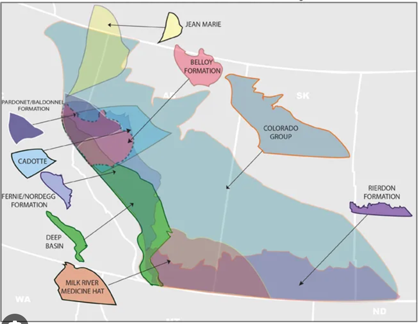
Low-Decline, Inventory-Rich, and Strategically Flexible
The Canada Deep Basin doesn’t get headlines anymore—and that’s exactly the point.
For leading Canadian producers, the Deep Basin has quietly evolved into something far more valuable than a growth engine: a cash-efficient, low-decline platform that stabilizes production, protects free cash flow, and absorbs operational optimization without demanding incremental capital.
Across earnings calls and 2026 outlooks, one message is consistent: the Deep Basin is not being asked to grow aggressively—it’s being asked to perform.
The Deep Basin’s Modern Role: Optimized, Not Overextended
Today’s Deep Basin strategy is built around three core attributes:
- Low-decline production
- Deep, repeatable inventory
- Infrastructure-backed flexibility
Rather than chasing volume growth, operators are extracting value through optimization, cost control, and disciplined capital allocation.
That shift is especially visible inside Montney-adjacent portfolios, where the Deep Basin shows up through assets like Musreau, Gold Creek, and Karr—areas that quietly underpin corporate cash flow.
Whitecap Resources: The Deep Basin as a Cash Engine
Whitecap’s messaging around the Deep Basin is unambiguous: optimize what you already own.
Management highlighted several key themes:
- Operational optimization
Gas lift, artificial lift tuning, and infrastructure debottlenecking are delivering measurable improvements. - Base production uplift
Montney-related volumes ran approximately 4,000 BOE/d above internal forecasts in Q3, driven by execution—not capital expansion. - Lower drilling costs at Musreau
Recent pads delivered roughly a 20% reduction in drilling costs, reinforcing the basin’s margin durability. - Steady-state development
Development continues within existing infrastructure, limiting capital creep.
The takeaway:
Whitecap is treating the Deep Basin as a cash-efficient, optimized engine, not a swing-growth lever.
That positioning aligns directly with its broader 2026 framework:
lower capital, flat production, higher free cash flow.
How Tourmaline Oil Corp Positions the Deep Basin
Tourmaline’s framing is just as deliberate—but slightly different in emphasis.
The Deep Basin is consistently described as a core, long-life gas complex, yet it is not positioned as the company’s primary growth driver. That role belongs to Northeast BC Montney, where returns are structurally higher.
Instead, the Deep Basin functions as:
- A flexible, low-risk gas platform
- A source of inventory depth and optional growth
- A lever for cost compression and operational efficiency
Think of it as a supporting asset that strengthens the portfolio rather than stretching it.
1. Capital Allocation: Selective by Design
Tourmaline was clear—both explicitly and implicitly—about how capital flows:
- Capital is selectively allocated, not aggressively ramped
- Growth dollars prioritize Northeast BC Montney
- The Deep Basin is expected to:
- Sustain base production
- Deliver incremental growth when pricing supports it
- Absorb capital reallocated from divested assets (such as Peace River)
Key implication:
The Deep Basin competes internally for capital—and still earns investment—but only when returns clear a high hurdle.
2. Cost Reduction Is the Primary Objective
Management emphasized execution over expansion.
Targets include:
- Approximately 5% OpEx reduction in 2026
- Continued D&C cost reductions
- Corporate efficiency initiatives flowing directly into Deep Basin operations
An important nuance:
These savings are not yet fully embedded in the multiyear plan. Management wants to prove the improvements first, then formalize them.
What this signals:
The Deep Basin is viewed as a controllable margin lever—a place where scale, execution, and repetition can materially improve economics without relying on higher commodity prices.
3. Exploration & Inventory: Quietly Strategic
While understated, exploration remains meaningful.
Management confirmed:
- Ongoing new pool and follow-up delineation drilling
- Inclusion in Q4 2025 and 2026 programs
Successful exploration could:
- Replace volumes from Peace River over the next 2–3 years
- Extend inventory organically
- Reduce the need for acquisitions
This gives Tourmaline optionality—supporting portfolio reshaping without increasing capital intensity.
The Bottom Line
The Canada Deep Basin has matured into exactly what disciplined operators want in 2026:
- Low-decline
- Inventory-rich
- Infrastructure-backed
- Highly optimized
- Free-cash-flow reliable
It’s no longer about growth optics.
It’s about durability, flexibility, and execution.
And in a capital-constrained world, that makes the Deep Basin quietly indispensable.