

The AUTRY development program in Martin County, Texas, is showing early signs of a large-scale multi-pad shale manufacturing project within the Midland Basin portion of the Permian Basin.
Using a 50-meter surface clustering methodology, the development was grouped into four distinct surface pads containing 28 planned horizontal wells across the AUTRY 5-8 and AUTRY 32-8 leases. Permit sequencing indicates a tightly coordinated drilling strategy, with an average of just six days between the first and last permit dates on each pad — a strong indicator of manufacturing-style development planning.
Although only one well has been spud to date — AUTRY 32-8 F on PAD-4 using Ensign Rig 773 — the remaining 27 undrilled wells suggest the project is still in the early execution phase with substantial future drilling inventory remaining.
From both a surface and sub-surface perspective, the AUTRY program displays many of the characteristics now commonly associated with modern Midland Basin cube-style development strategies:
- high-density multi-pad layouts
- shared infrastructure planning
- phased drilling execution
- stacked-pay reservoir targeting
- centralized acreage development

Surface Development Analysis
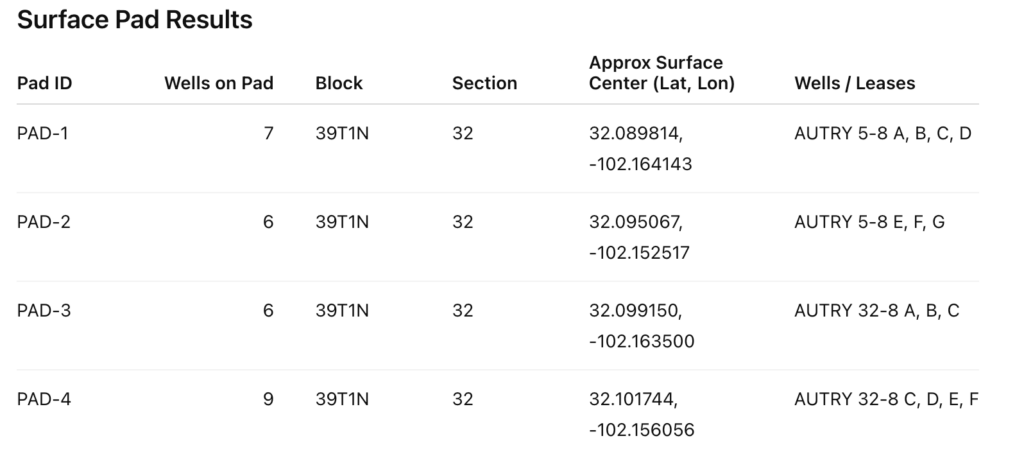
The surface review identified four separate drilling pads concentrated within Section 32, Block 39T1N.
Pad Wells Approx Surface Center Primary Lease PAD-1 7 32.089814, -102.164143 AUTRY 5-8 PAD-2 6 32.095067, -102.152517 AUTRY 5-8 PAD-3 6 32.099150, -102.163500 AUTRY 32-8 PAD-4 9 32.101744, -102.156056 AUTRY 32-8
Key Surface Metrics
- Total Wells: 28
- Total Pads: 4
- Active Rig: Ensign 773
- Basin: Midland Basin — Permian
- Development Type: Multi-pad horizontal shale manufacturing project
The tight clustering of the pads suggests the operator controls a highly contiguous acreage position and is executing a centralized development strategy designed to maximize operational efficiency while minimizing surface disturbance.
Among the four locations, PAD-4 currently appears to be the operational centerpiece of the project. It contains the only active spud well and the largest planned inventory, positioning it as the likely lead pad for the broader development campaign.
The overall surface layout strongly supports several operational objectives commonly seen in large Permian programs:
- centralized infrastructure utilization
- reduced mobilization costs
- shared completion operations
- long-term manufacturing scalability
- lower environmental footprint through pad concentration
Drilling Depths Suggest Multi-Bench Development
Sub-surface analysis indicates all wells target the Spraberry Trend Area using horizontal drilling techniques.
Projected well depths range from approximately 11,200 feet to 13,100 feet, with total planned drilling footage exceeding 339,000 feet.
Pad Min Depth Max Depth Average Depth Planned Footage PAD-1 11,200 ft 11,850 ft 11,525 ft 80,675 ft PAD-2 11,400 ft 12,000 ft 11,700 ft 70,200 ft PAD-3 12,100 ft 12,650 ft 12,375 ft 74,250 ft PAD-4 12,250 ft 13,100 ft 12,675 ft 114,075 ft
One of the most notable trends is the gradual increase in projected depths moving from PAD-1 through PAD-4. This pattern strongly suggests the operator may be sequencing development across multiple benches within the Wolfcamp and Spraberry system.
The depth progression, combined with the dense pad spacing and phased permit timing, points toward a coordinated stacked-pay development model rather than isolated single-zone drilling.
Evidence of Co-Development Strategy
Several indicators support the conclusion that the AUTRY program is being designed as a co-development project:
Co-Development Indicators
- All wells are located within the same section and block
- Entire program falls within the Spraberry Trend Area
- 100% horizontal well design
- Dense multi-pad geometry
- Similar depth windows across pads
- Coordinated permit sequencing
- Manufacturing-style inventory buildout
Collectively, these indicators are highly characteristic of Midland Basin cube-development programs where operators simultaneously develop multiple reservoir benches to maximize reservoir contact and long-term recovery economics.
The project also appears structured around shared infrastructure and centralized completion operations, which can significantly improve capital efficiency across large drilling inventories.
Geological and Operational Interpretation
From a geological perspective, the AUTRY development program reflects a modern unconventional resource manufacturing model focused on:
- stacked reservoir exploitation
- multi-bench horizontal development
- centralized infrastructure planning
- phased execution sequencing
- long-duration drilling inventory
The deeper projected depths observed on PAD-4 may indicate targeting of deeper Wolfcamp intervals, while the shallower pads likely focus on upper Spraberry or intermediate benches.
Overall, the project exhibits many of the operational hallmarks currently driving large-scale Permian Basin development:
- cube-style development planning
- simultaneous bench extraction
- high-density pad drilling
- infrastructure-sharing optimization
- long-term manufacturing scalability
While still in the early stages operationally, the AUTRY program already demonstrates a highly structured and coordinated development approach consistent with modern Midland Basin shale economics.

Author: phinds